

Intelligent test design
How AI transforms test design
Dedicated AI solutions can be applied to verify specifications, assisting with the analysis of requirements, which allows QA teams to streamline the following areas:

Incremental test design updates
When business requirements evolve, AI tools quickly identify every affected test scenario, eliminating the need for tedious manual comparisons. This ensures that test suites stay aligned with the latest requirement changes, preventing outdated testing coverage and unreviewed functionality.

Edge case and boundary detection
AI solutions can detect critical boundary values, negative paths, and complex state transitions that can be overlooked during manual review. It helps ensure that high-impact issues are resolved before the product is released.

Real-time traceability mapping
AI automatically bridges the gap between specifications and test scenarios, generating a traceability matrix and keeping it updated in line with every change. This provides up-to-date visibility into the testing landscape.

Spec-driven scenario generation
By converting complex specifications into ready-to-use testing scenarios, AI ensures that the testing logic is fully aligned with project goals. This helps remove the ambiguity of manual interpretation, linking requirements directly to test cases.
Proven benefits of AI-driven test design
By embracing the AI-driven approach, QA specialists can gain tangible improvements across the entire delivery life cycle:
Complete test coverage
Through an AI-driven audit of the entire requirement set, project stakeholders gain a real-time view of the test coverage and requirement validation status and can ensure that every user story is backed by a test suite that evolves alongside the IT product.
Fewer overlooked defects
Integrating AI into the early stages of test creation helps uncover hidden edge cases that typical test planning may miss, enabling teams to identify and address defects in the functionality before they reach end users.
Faster test design
Streamlining the test design phase with AI reduces manual efforts and shortens cycles necessary to create test cases, ensuring that software delivery timelines stay on track.
Consistent software quality
By shifting from manual drafting to AI-governed design, QA teams guarantee that every component of an IT product is validated against the same deep-logic standards and architectural rules.
Full traceability
AI tools automatically establish clear links between requirements and test cases, making it easy to trace each test back to its originating requirement and assess the impact of any change.
Knowledge transfer
New engineers can quickly get an idea of how the application works using requirements, project documentation, and AI-generated tests as a practical reference to the system’s behavior, which speeds up and simplifies the onboarding processes.
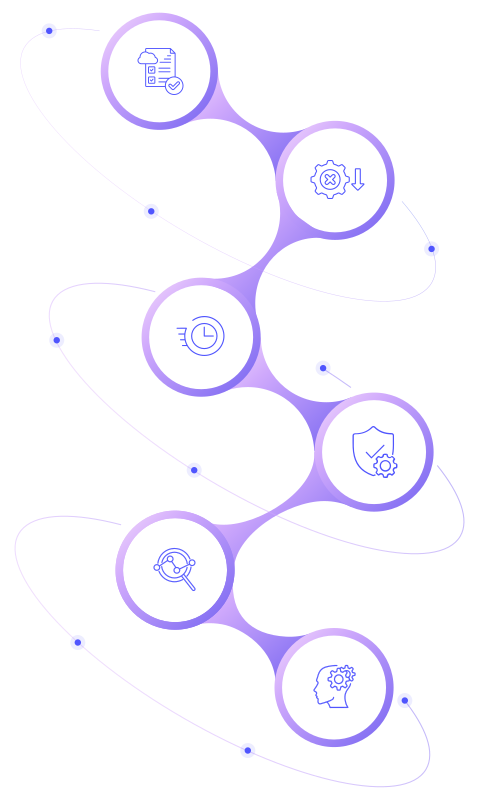
Our approach to transitioning to AI in test design
We gradually embed AI into your test design workflows to deliver measurable improvements without operational overhaul.
Preliminary audit
We evaluate your existing requirements and test cases to ensure they can be used for AI-driven test generation. By identifying documentation gaps and missing acceptance criteria, we pinpoint areas where requirements can be strengthened and highlight immediate ways to improve coverage, turning your existing assets into high-quality inputs for automated testing.

Pilot generation
We launch a proof-of-concept where AI drafts testing scenarios for 1–2 selected defined sets of requirements. Our specialists then perform a direct comparison with your manual test cases, ensuring that AI’s output aligns perfectly with your technical standards.

Refinement
We align AI prompts with your internal standards. This enhancement helps create standardized test design practices for your IT product, ensuring that AI-driven outputs remain consistent and high-quality.

Scaling
We expand the refined AI-powered test design solution, ensuring full coverage for your entire application. By integrating AI directly into your existing test management tools, our QA engineers ensure that your test scenarios evolve automatically as your specifications change.


How our spec-driven design works

Input
We aggregate your user stories, acceptance criteria, API specs, Figma flows, business/product requirements documents into a knowledge base.

AI processing
By analyzing your documentation, AI identifies what to test, explores boundary risks, and creates a traceable suite of scenarios ready for execution.

Output
You receive a polished set of test cases with steps, expected results, priority levels, and requirement traceability.

Human review
Every AI-designed test needs to be manually reviewed, with QA engineers validating the alignment of its results with requirements and business rules, refining test scenarios, and approving the final test set before execution.
When to introduce AI-driven test design

Lack of traceability between specs and tests
As applications grow in complexity, disconnect between written specifications and automated scripts may lead to situations when no one can confirm full requirement coverage during critical reviews. It requires expensive manual audits to verify that the software does what the business intended.

Compliance burdens
In regulated industries such as healthcare, fintech, or insurance, one must provide evidence that every requirement is covered. When manual documentation can’t keep pace with rapid development, the compliance gap can create legal and operational risks.

Changing requirements
Considering high development speed, traditional test design becomes the primary friction point in the release cycle. This can cause cases when test logic reflects last month’s requirements rather than the latest requirement updates, which requires expensive, last-minute manual intervention to ensure that the latest business logic is validated before the go-live.

Legacy systems with poor documentation
When teams work with undocumented legacy systems, vital business logic may exist only in engineers’ memory rather than in formal specifications. This lack of artifacts complicates impact analysis and increases the risk of unexpected side effects during system updates. AI can build test scenarios for existing functionality and make implicit system behavior more transparent.

Production issues
Under the stress of delivery, QA engineers may miss what-if scenarios that define robust software. It results in a fragile release where edge-case failures bypass traditional quality gates, turning production environments into places where errors are found.

Why a1qa?

A culture of quality
We minimize business risks, eliminate high costs of late-cycle rework, prioritize client needs throughout the entire development life cycle, and accelerate time-to-market through efficient QA processes.

Proficient QA teams
We make sure all our specialists continuously develop soft and hard skills, stick to Agile mindset to respond quickly to changing circumstances, and keep pace with evolving technologies to drive rapid innovation.

Innovative tech stack
We continuously explore and implement the latest and most effective QA tools, frameworks, and programming languages (Playwrite, Cypress, C#, Python, etc.), ensuring our processes remain efficient and our teams capable of delivering high-quality results faster and with greater confidence.

Comprehensive suite of QA services
We provide end-to-end QA solutions tailored to your product’s unique needs, combining manual and automated testing approaches to guarantee reliability, scalability, and seamless user experiences.
Frequently asked questions
AI-driven test design is vital for high-risk, complex software solutions. It replaces manual guesswork with automated precision, helping teams effectively test software logic, multi-layered integrations, and compliance demands. By exposing hidden edge cases, AI ensures total coverage and improves quality of IT products.
No, but it improves QA engineers’ capabilities by automating scenario generation and risk analysis, allowing experts to focus on strategy, exploratory testing, and other high-priority business activities.
Yes. AI-driven test design fits naturally into ecosystems where speed, adaptability, and continuous validation are essential. It enables teams to generate and update test scenarios in parallel with evolving requirements, ensuring that testing keeps pace with frequent releases.