

Software lifecycle QA
Reach your business objectives with full-cycle testing

End-to-end test coverage
Throughout lifecycle QA, we conduct all needed types of testing: functional, performance, security, GUI, usability, database, compatibility, accessibility, localization, and more to ensure an optimized test coverage.

Complete process transparency
We provide complete transparency of our software testing activities and take full responsibility for them. Also, we seamlessly integrate with your business and development processes for full testing alignment.

Established KPIs
We always establish the most important QA KPIs and keep you informed about their status that you can track our progress with the testing tasks and check if our intermediate results align with your goals.
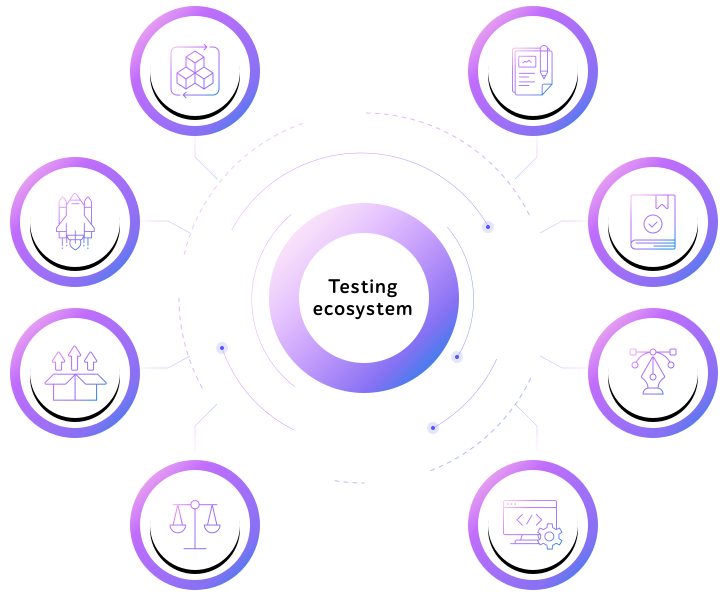
One testing ecosystem for all SDLC stages

1. Documenting
- Documentation testing

2. Requirements
- Requirements testing

3. Design
- Prototype testing
- Usability testing
4. Development
- Unit testing
- Integration testing
- Test automation

5. Stabilization
- Intermediary testing

6. Delivery/release
- Reproducing issues
- Identifying root causes

7. Production
- Acceptance testing
- Migration testing

8. Regression testing

…I feel I'm in excellent hands and have seen our quality improved and maintained despite the significant growth in our code base and application complexity over time. I have no hesitation in recommending a1qa as an outstanding provider of QA services.






Already have a QA team?

Benefit from our 20+ years of industry and technology expertise accumulated in our proprietary:
Centers of Excellence (CoE)
Services:
- Security testing
- Mobile application testing
- QA consulting, and more
Industries:
- Retail
- Telecom
- BFSI
R&Ds
- Test automation
- Performance testing

Advance with our well-defined testing approach comprising the detailed definition and confirmation of:
- Project stages and goals
- Testing types and coverage
- Testing documentation
- Proven testing methods
- Project success criteria and KPIs
A-to-Z reporting on every stage of software development
Capable of showing high productivity from the get-go, we deliver clear and complete testing results, keeping you informed about the product quality status.

- Quality reports
- Build/release reports
- Iteration results
- Delivery reports

Type-specific reports
(performance, accessibility, compatibility, usability, etc.)

- Test status reports
- Daily status reports
- Test efforts reports
- Monthly efforts reports


Why choose lifecycle QA by a1qa?

Years of evolving
QA expertise
With a 20-year track record in SQA, we have gathered technology-centric QA expertise across a variety of industries (IT, BFSI, telecom, retail, eHealth, and more).

A pool of motivated
QA Jedi
In our in-house QA Academy, skilled tutors work tirelessly to conduct exclusive training for QA engineers and managers to update their skillsets in specific industries and technologies.

Complete QA support
throughout SDLC
Excelling at the complete range of testing services, from functional testing to Agile QA, we wisely pick the best options for you depending on your software type, product specifics, and business needs to be met.
Frequently asked questions
a1qa ensures transparency by clearly defining and tracking key QA KPIs, fully aligning our testing activities with your business and development workflows, and regularly updating you on the status of all testing processes.
Our lifecycle QA services include a comprehensive range of tests, such as functional, performance, security, usability, GUI, database, compatibility, accessibility, localization, and more, ensuring complete and optimized test coverage across all software development stages.
We can perform testing throughout the entire software development lifecycle, from initial documentation and requirements testing to unit, integration, and automation testing during the development, stabilization and acceptance testing at the release, all the way through regression testing post-deployment.
Full-cycle QA spans the whole software development process, where we take part in the project from the planning and layout stages through building, checking, and deployment. Standalone testing efforts focus on individual activities, such as performing tests or confirming functionality at a certain time.
We work alongside your in-house QA team rather than replacing it, but the setup depends on the engagement model. In staff augmentation or dedicated resource models, we support your existing members, while in managed testing or fixed-scope projects, we can handle the entire testing life cycle ourselves. Such versatility allows you to adjust support levels based on the demand without causing friction in your ongoing processes.
We measure KPIs related to quality, speed, and output throughout the project, such as defect density, defect leakage, test reach, execution status, automation depth, and more. We also track cycle speed, rework hours, release stability, and metrics to see how proactive testing affects the total timeline.
We evaluate them early to catch contradictions and poorly defined criteria before the development phase. QA engineers ensure requirements are verifiable, map out test logic, and pose questions about risks during meetings. This prevents costly rework as the development cycle moves forward.
QA engineers integrate into existing workflows and engage with developers as part of one unit. This includes regular presence on project meetings and shared chats for immediate feedback and task tracking. We also ensure detailed reports, structured workflows, and steady feedback to guarantee everyone stays on track and avoids common misunderstandings.
We seamlessly adjust team size to fit your changing demands depending on the service model in place. In case of team extension or dedicated team arrangements, people can be allocated fast, while managed solutions or fixed-cost projects provide for organized scaling aligned with milestones and schedules.
They build tailored AI-driven test automation frameworks, nurture a proper client-side testing solution, develop load testing strategies, analyze cutting-edge tech trends, and nurture in-house expertise to streamline your QA workflows and help you gain access to the latest technology advancements and constant upgrades.