

AI implementation rescue
Turning AI initiative into effective solutions
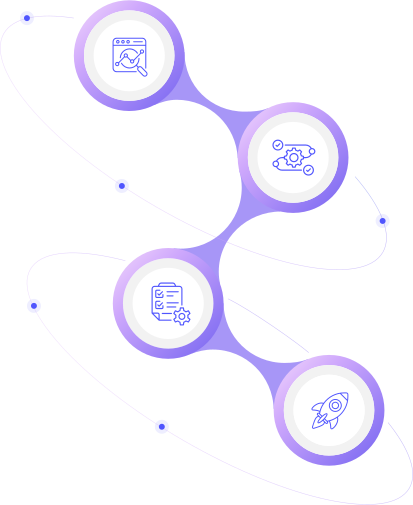
Phase 1. AI quality audit (1 week)
We explore your AI implementation case by comparing original goals with real performance and identifying problems and their root causes.
Phase 2. AI system stabilization (2-3 weeks)
We contribute to stable AI outcomes by improving specification quality, stabilizing data pipelines, and implementing missing governance practices (e.g., policies, monitoring, and control mechanisms for AI systems).
Phase 3. Structured expansion (3-4 weeks)
We move from a stabilized pilot toward production, proceeding to each new phase – assessment, feasibility, validation, and scale – only when defined criteria are met.
Phase 4. Rolling out the results (1-2 months)
We ensure your team can run AI-assisted quality engineering independently. Clear playbooks, measurable metrics, and defined processes replace reliance on any external vendors.
Real reasons behind AI pilots’ failure

Failure patterns
- AI guesses missing structure or meaning in input data without functional specifications
- There are no starting metrics to validate actual performance improvement from AI implementation
- AI pilots aren’t productionized due to unresolved issues in reliability or scalability
- Vendor prioritized sales over AI solution stability

a1qa’s rescue approach
- We validate and structure input data to ensure consistent and robust AI outputs
- Every improvement in AI solution performance is measured against baseline metrics
- Clear decision criteria are defined to determine whether an AI solution is ready for production
- Honest disclosure when a project is beyond repair
Primary success indicators we monitor

Specification readiness score
It measures how well specifications support effective AI usage and consistent outputs.

Baseline gap
It highlights the distance between where the AI project is today and where it’s expected to be in the future.

AI output quality
It indicates how many AI-generated tests are usable in practice versus those that require correction or replacement.

Time to value
It evaluates how quickly measurable improvements appear following the start of the recovery effort.

AI implementation situations we rescue

Poor test generation quality
AI tools create tests, but they lack stability, miss critical scenarios, and are hard to manage. The problem usually lies in vague specifications, which we optimize to guide AI toward more comprehensive test scenarios.

Compliance problems
The project reached a compliance barrier before full deployment. We build the necessary data diagrams and define AI usage policies to ensure a smooth compliance review and approval process.

ROI visibility gap
Without clear measurement of AI impact, AI success turns into a guess. Our team builds the reporting framework to highlight your tangible gains from AI adoption.

Vendor-driven stagnation
The vendor left a working system without a manual. We audit the current solution and provide a clear plan for what to keep or upgrade.

Unused AI assets
AI solution is deployed, yet engagement remains low. a1qa’s specialists pinpoint why users resist and rebuild the process to ensure the solution’s high adoption.

Why opt for a1qa’s approach to rescuing AI implementation projects

Honest assessment
We analyze your AI solution and provide a straightforward explanation of what’s broken and why. We value honesty, even if the only answer is that the project can’t be rescued.

Decision clarity
Every recommendation we make is backed by a thorough analysis. Findings boil down to three primary options: keep the setup, fix the issues, or completely discard the solution.

Team upskilling
In addition to service provisioning, we focus on building internal expertise. By the end of our collaboration, your team understands how to use, maintain, and evolve AI-empowered testing workflows independently.

Fixed foundation
We optimize the pillars of your AI ecosystem. From clean documentation to CI cycles, we ensure every aspect is 100% reliable.

Measurable progress
Growth is monitored from the outset. By setting up a baseline and tracking KPIs, we deliver weekly evidence of how performance evolves.

Risk management
The recovery process is designed to minimize risk. With defined review stages, measurable thresholds, and contingency plans, every step is carefully validated.
Why a1qa?

Continuous learning
We make sure our QA engineers, managers, and architects deepen their professional skills and extend their expertise within our centers of excellence (CoEs), research and development labs (R&Ds), and 100+ courses at the internal a1qa Academy.

High flexibility
We quickly ramp up and scale down the teams based on changing project workflows to help our clients meet set business objectives and feel confident in every software release.

Exceptional care
We believe employee engagement is the engine of client satisfaction. That’s why we offer social and financial benefits for every employee regardless of their geographical location, job position, professional maturity, gender, and occupation.

In-house mobile ecosystem
We leverage and continuously expand the fleet of 300+ real mobile devices to increase process efficiency and provide more accurate testing results.
Frequently asked questions
It’s a targeted evaluation and recovery framework for AI initiatives that have plateaued, missed targets, or hit technical walls. Our specialists analyze failures, secure core assets, and decide if the path forward involves a pivot, a total rebuild, or an exit.
A standard review takes several months to complete, based on the specific logic and the scope of the API ecosystem. We use this phase to examine the logic of your AI systems (models, prompts, workflows), capture baseline metrics on its output quality, speed, and reliability (e.g., accuracy, latency, error rates), and present opportunities for a full recovery.
Sure. We audit your current technology stack to decide if components should be retained, tuned, or swapped out. Most recovery projects focus on maximizing the value of your existing licenses and tools instead of forcing a migration to new platforms.