

AR & VR testing
Virtual and augmented reality testing for every application

Enterprise AR & VR

Consumer-grade AR & VR

AR & VR games
Why go for augmented & virtual reality testing
Hedge against performance hiccups during immersive experiences
Guarantee your UX and UI are user-centric
Ensure your AR & VR app operates flawlessly across devices and platforms
Make certain the visuals are rendered just like you envisioned them, creating a seamless digital world
Safeguard sensitive user data against cyberattacks
Get an objective assessment of your AR & VR solution and expert advice on how to improve its performance, scalability, and future development
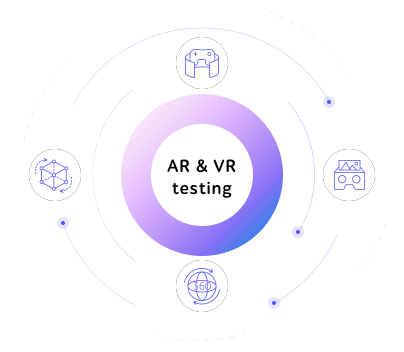

How we approach virtual and augmented reality app testing services

Hardware testing

Performance testing

Mobile application testing

Security testing

Usability testing

Compatibility testing

We deliver industry-specific AR & VR testing

Banking and finance
- Virtual trading
- VR payments
- Data visualization

eHealth
- Medical training
- Augmented diagnostics
- Pain management and relief

Logistics
- Warehouse planning
- Cargo loading
- Vision picking

Retail and eCommerce
- Virtual showrooms
- AR-equipped fitting rooms

Education
- Interactive learning
- Virtual classes
- Event recreation

Marketing and advertising
- AR-enhanced branding materials
- Immersive marketing campaigns

Gaming
- AR/VR games for mobile devices and gaming consoles

Real estate
- Virtual location tours
- Architectural and design visualizations
- Interactive blueprints

Travel and hospitality
- Monument augmentation
- Interactive exhibitions
- Virtual hotel tours
Meet the team who’ll make your AR & VR app fault-free

Experts in AR & VR technology
Driven by a solid expertise in AR & VR, a1qa knows exactly where to look for potential bugs and defects.

Testing veterans
With 20+ years of testing across multiple domains, we apply only tried-and-true methods, tools, and technologies.

Case-by-case approach
Our team will focus on the granular details and challenges of your AR & VR software product to deliver bespoke testing services.

Focus on quality and compliance
We strictly follow the ISO 9001 and ISO 27001 quality standards as well as case-specific industrial and regional compliance frameworks.
Frequently asked questions
We can conduct testing for a range of applications, including enterprise AR & VR business solutions, consumer-grade applications, and AR & VR games. All in all, we help ensure that both enterprise applications and commercial products function seamlessly and deliver a reliable user experience.
To ensure comprehensive testing, we provide hardware testing, performance testing, mobile application testing, security testing, usability testing, and compatibility testing to detect any weak spots, flaws, or vulnerabilities in AR & VR applications.
By conducting thorough testing, companies can timely detect and mitigate performance hiccups during immersive experiences and ensure that user interfaces and user experiences are engaging and seamless.
We track vital factors like frame rate, latency, and movement patterns during long-term sessions. By merging technical metrics with direct user feedback, we pinpoint discomfort triggers and refine the overall immersion to address them.
The first option emphasizes large-scale usage, where a wide range of users test software in natural settings to find defects involving performance, hardware usage, and user comfort. The second option is performed in managed environments and is used to assess specific UI design, navigation, and user workflows.
Sure, we audit energy usage during lifelike scenarios, involving sustained operations and complex interactions. This includes investigating CPU/GPU overhead, frame rate delivery, and background services that contribute to power waste. Thus, we detect inefficiencies and ensure that the battery lasts long enough for everyday use.
We recreate actual world scenarios that impact tracking, spatial data, and user input. This involves testing functionality in cramped or vast areas, along with different brightness scales ranging from dim rooms to harsh or flickering lights. Our aim is to provide stability and ease of use in any physical environment.
Our team measures how individuals with different physical, visual, or learning challenges interact with content. We review alternative control schemes, interface readability, audio-based support, and simplified interactions that don’t require high precision.
AR/VR tools manage high-risk data such as optical feeds, environmental maps, and biometric signals like motion or eye tracking, which can expose details about user’s surroundings, lifestyle, or identity if not guarded. Securing AR/VR also entails protecting raw sensor data, device-to-cloud links, and restrictive access layers.
We run standard interaction tests and measure real-time feedback against target movements and signals. Our specialists examine how effectively the system captures hand coordinates, recognizes specific gestures, and processes controller data at different operation speeds, detecting problems such as lags, signal errors, or irregular detection that might impact overall control.