

AI-generated code audit
Risks in code that evolves faster than review cycles

Missed business goals
Software can pass tests yet fail actual business rules, or introduce unnecessary features.

Production failures
Code that passes quick checks breaks under real workloads and data.

Exceeded review capacity
AI generates more code than teams can effectively review, pushing you to choose between faster releases and full confidence in quality.

Lack of architectural ownership
Teams integrate model-generated code without full understanding, resulting in unclear ownership and increased risk in maintenance.
What we assess

Business-goal alignment
We validate behavior against your business rules, workflows, and acceptance criteria, identifying unnecessary or missing functionality.

Risk-based prioritization
We rank system components by production impact, integration risk, and change frequency, using your architecture to decide what matters most.

Escaped defects
We identify AI-specific defect patterns most likely to bypass testing and reach production, detailed below.
AI-generated code defects and their impact

Hallucinated dependencies
Defect cause
AI references non-existent or misused libraries and functions.
Why it matters
Code passes demos but breaks at runtime.

Incorrect integration assumptions
Defect cause
Wrong assumptions about APIs, data contracts, or permissions.
Why it matters
Code fails when interacting with real services and data.

Incomplete or wrong business logic
Defect cause
Missing rules, edge cases, or incorrect implementation of requirements.
Why it matters
Tests pass, but business outcomes are faulty.

Insecure patterns
Defect cause
Exposed secrets, unsafe authentication, insufficient validation, or risky dependencies.
Why it matters
Introduces common and potentially critical security vulnerabilities.

Architectural drift and over-engineering
Defect cause
Code misaligned with target architecture and addition of unnecessary components.
Why it matters
Increases maintenance overhead and creates early technical debt.

Observability and test coverage gaps
Defect cause
Lack of logging, monitoring, or test coverage on critical paths.
Why it matters
Failures remain undetected until they impact end users.

How we evaluate AI-built applications
-
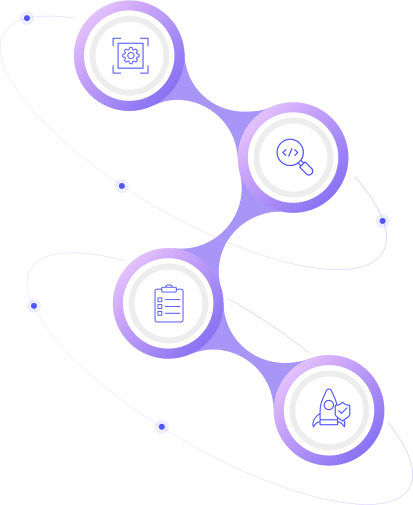
Scope definition
We agree on the target functionality, required access, and expected business outcomes.
-
Audit execution
We perform three core assessments (business-goal alignment, risk-based prioritization, escaped defects), with senior QA review of every finding.
-
Remediation
You receive a prioritized, execution-ready roadmap outlining agreed fixes, responsible owners, defect SLAs, progress tracking, and 3-month targets aligned to the audit baseline.
-
Implementation
You can implement independently or with our support. We provide targeted exploratory testing and business-rule validation, as well as establish release gates and automated checks to mitigate recurring risks, typically within three months.
Why objective assessment is essential

No delivery bias
Delivery teams are measured on output, while we provide an objective assessment based on release readiness evidence.

A verdict the business can act on
An external decision, with severity, owner, reproduction path, and a gate recommendation, that you can put in front of leadership and customers.

Why a1qa?

Proficient teams
We leverage a talent pool of 1,000+ QA professionals working across multiple software testing areas, which enables us to assemble project-specific teams with the required expertise.

Advanced toolkit
We operate on a modern, carefully selected QA technology stack, which helps us ensure high testing efficiency and deliver quality results faster.

World-class processes
We strictly adhere to ISO 9001/27001/14001 standards, ensuring consistent service quality, strong security practices, and more sustainable processes.

Continuous development
We accumulate domain and technical expertise across 10+ CoEs and R&Ds, designing custom training at our exclusive Academy to help our QA engineers upskill and stay aligned with modern QA practices.
Frequently asked questions
AI-code assurance is an independent audit of code produced by AI, coding agents, or vibe coding, verifying it’s production-ready, architecturally sound, and able to solve the business problem, while preventing any issues in live environments.
Engineering and product leaders (CTO, VP of Engineering, Head of Quality) at companies already shipping AI-generated software, especially fast-moving teams where developers accept AI or agent output they may not fully understand.
We target the failure modes specific to AI-generated code, such as architecturally inconsistent decisions, silent business-goal drift, hidden technical debt, and untested edge paths, reviewed independently rather than by the team that wrote (or prompted) the code.
After the work is completed, our QA team provides a clear report containing architecture review, business-goal conformance, test-coverage gaps and risk or defect hotspots, and a prioritized remediation plan you can act on.
The major problem is that when the team spends too much time working with the code, the engineers can accidentally overlook issues. That’s why an impartial evaluation is what your board, customers, and auditors can actually trust.
Yes, we need read-only access, and our QA engineers will perform all activities under an NDA. We can work within your secure or on-premises environment, and we don’t need to retain your code.
The assessment delivers findings and a remediation plan. We can also provide remediation and retesting activities as a subsequent engagement if you’d like us to close the gaps.
The audit is methodology-driven and applies the same standards for architecture soundness and business fit across technology stacks. We cover all major languages and frameworks, so we’ll confirm the scope based on your preferences.
A typical assessment runs from a few days to a couple of weeks, depending on the codebase size and scope. We’ll agree on the milestones upfront before we start.
Feel free to book an assessment, during which we’ll scope your codebase, run the audit, and deliver the report and remediation plan.