Blog

QA metrics for managers: defects and developers

When running these metrics pay special attention to the fact how long it took to fix the defect and which step was most intense.
25 October 2013
Quality assurance
Article by Dmitry Tishchenko
Head of global business development at a1qa

In previous articles we discussed, how to define the quality rate, evaluate testers` capacity and covered bug description method. All these things concerned tester`s work, but a tester is the one who detects a bug, while a developer fixes it. So this time I would like to cover some bits of a DEVELOPER`s niche on the QA consulting map. Taking bug statics as a basis, I want to tell about the indexes that reflect developer`s work efficiency.

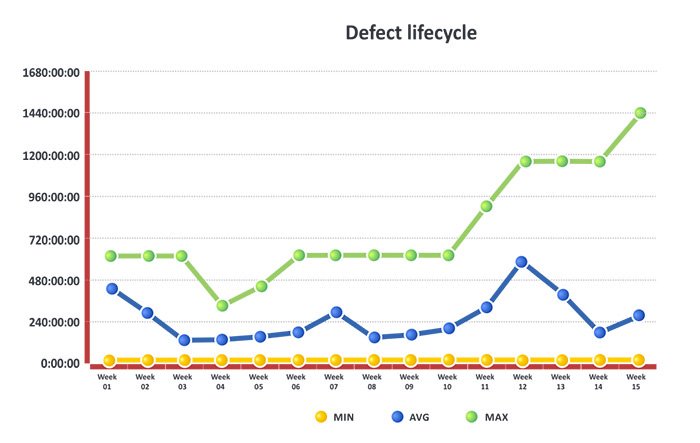
First one is about defect lifecycle continuity. The index comprises “defect processing period”, “defect fixing period” and some other elements.

When running these metrics pay special attention to the fact how long it took to fix the defect and which step was most intense. Remember to track the index changes and put them in to the diagram, like this one, for example.

Defect lifecycle

The method of data collection resembles the one I described in the first article of QA metrics for managers, when told about defects having status “functions as designed”.

When you start calculating, you`ll see that index increases due to the defect lifecycle longevity. Considerable can be observed on stages like processing, assigning and queuing.
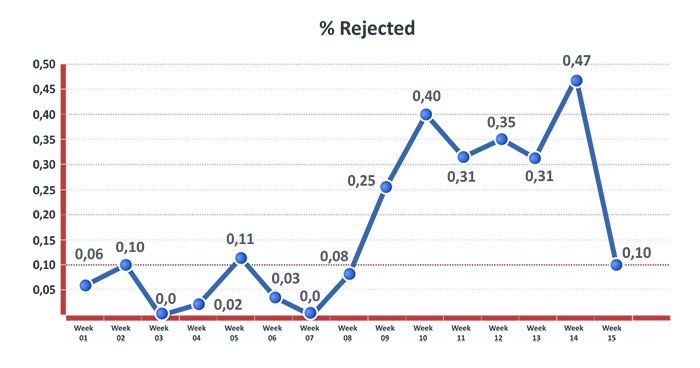
The other one index is the percentage of Rejected bugs. Defect is considered to be rejected, when a tester gives it status of a non-fixed one after checking. That means that a cycle has to be renewed: report to a developer, re-fix, re-check. The time is actually wasted for additional communication. On large scale projects such things cause additional expenditures, which is quite tangible.

Having exercised multiple projects, I noticed that 10% is an acceptable value for the index; try to keep to that limit. It is better to calculate the index after every release, especially on a large scale project, when more than two builds is released per week.

Remember to add the index in every report, to keep the tester and developer teams informed. Doing this you stimulate the team members to bring down the index percentage and define the positive work dynamics.


More Posts

15 December 2025,
by a1qa
4 min read
Compatibility testing: how to protect revenue, reputation, and delivery speed
Modern users expect your app to work first time on whatever device they pick up. A clear compatibility strategy helps your team uncover environment-specific defects before launch, cut noisy support tickets, and keep revenue critical journeys running smoothly.
Quality assurance
28 November 2025,
by a1qa
6 min read
Embarking on the journey ahead: QA trend playbook for 2026
Dive into the wave of QA advancements preparing to take center stage in 2026, arming yourself with the foresight you need to navigate any challenges with confidence. 
Blockchain app testing
QA trends
Quality assurance
Test automation
14 November 2025,
by a1qa
5 min read
QA’s role in a cloud move: before, during, and after
Do not wait until go-live to find bugs. Learn how a continuous QA strategy turns a high-stakes cloud move into a controlled success.

Cloud-based testing
Functional testing
Quality assurance
30 October 2025,
by a1qa
5 min read
Why media and entertainment needs smarter QA
Your audience expects instant, crystal clear streaming every time. Learn how the right QA approach helps your team catch issues before release, protect ad revenue and keep viewers watching.
Quality assurance
15 October 2025,
by a1qa
3 min read
5 signs you need test automation
When manual checks throttle delivery, speed and quality both suffer. If time to market is stretching and incidents keep coming, these five signals say automate now.
Quality assurance
Test automation
30 September 2025,
by a1qa
4 min read
eLearning with AI elements: a practical testing strategy leaders can trust
AI lifts learning outcomes and engagement, but it also raises risk. Here is a clear, business-first testing strategy that helps leaders release reliable AI-powered eLearning, adapt it to local needs, and prove value quickly.
Quality assurance
Test automation
11 September 2025,
by a1qa
5 min read
7 reasons why businesses need load testing 
Want to optimize software performance or ensure its smooth functioning during peak sales season? Discover how load testing may help.
Performance testing
Quality assurance
Test automation
14 August 2025,
by a1qa
4 min read
Output-based test automation, who gains the most?
Linking payment to clear testing deliverables sounds simple. Yet the model reshapes budgets, incentives, and release velocity. Here is how output-based engagement works, where it excels.
Quality assurance
Test automation
23 July 2025,
by a1qa
6 min read
Rewriting the rules: how AI is transforming game quality assurance
Better games, faster updates, happier players, sounds great, right? Learn how to achieve all of these with a smart QA approach.
Performance testing
QA in Gaming
Quality assurance
Test automation

Get in touch

Please fill in the required field.
Email address seems invalid.
Please fill in the required field.
We use cookies on our website to improve its functionality and to enhance your user experience. We also use cookies for analytics. If you continue to browse this website, we will assume you agree that we can place cookies on your device. For more details, please read our Privacy and Cookies Policy.