
Why media and entertainment needs smarter QA

The Media and Entertainment (M&E) industry has always been about creating memorable experiences. But today, those experiences must happen instantly, seamlessly, and across every device.
Consumers now expect perfect performance, no glitches, no buffering, no delays. They want their favorite show to start without a hitch, their gaming experience to be smooth, and their streaming apps to work whether they’re on a smart TV, tablet, or mobile device.
And if something goes wrong? They don’t wait, they move to another platform.
Consider these key facts:
- The global OTT (over-the-top) market is expected to exceed $1,241.6 billion by 2030.
- 60% of M&E businesses say improving user experience is their number one strategic priority (World Quality Report).
Delivering great quality at every digital touchpoint can be the difference between keeping a customer and losing them.
Current trends in software testing for media and entertainment
The way software is tested in M&E is evolving quickly. New tools, methodologies, and expectations are reshaping how QA teams work.
Here are the trends leading the way:
- AI and machine learning in QA
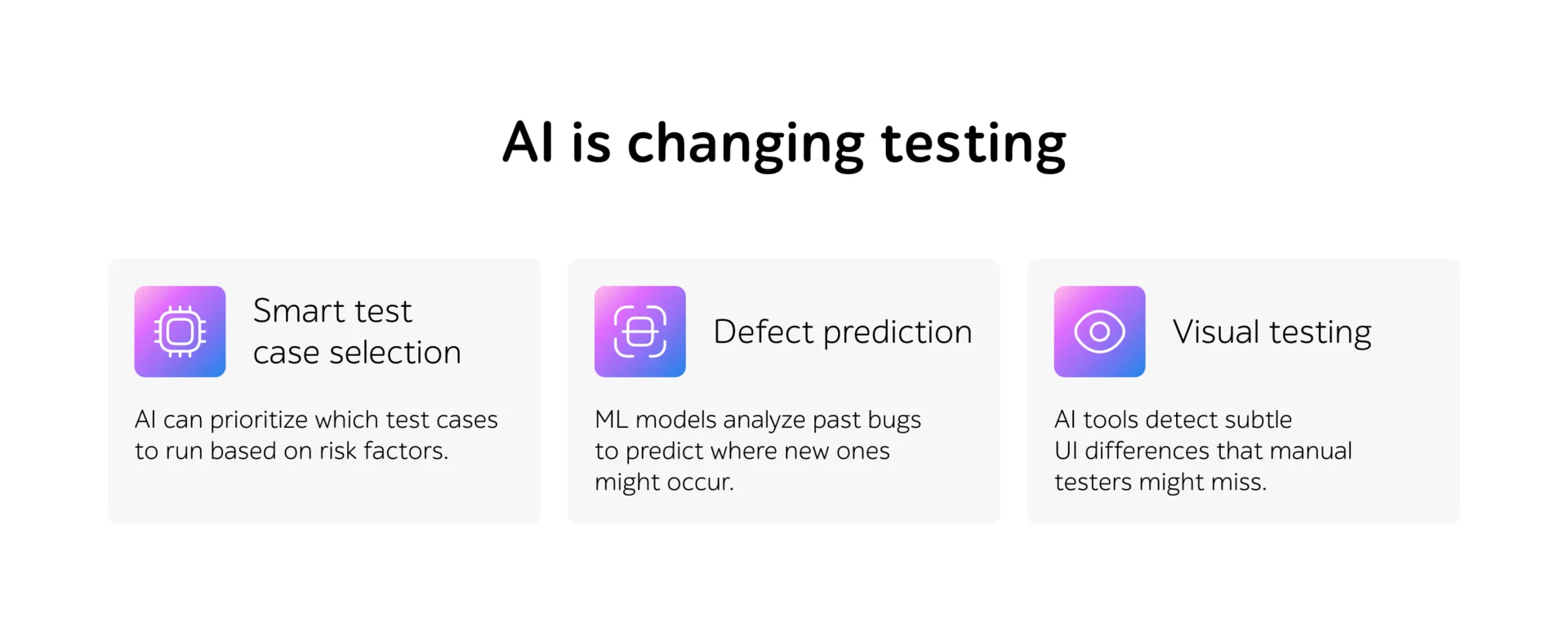
As a result, QA teams can speed up testing cycles, reduce the number of manual efforts, and ensure consistent quality across the entire development life cycle.
- Focus on performance and scalability
Teams are increasingly running stress, load, and soak tests to make sure apps can handle peak traffic, such as:
- Major sporting events
- Movie premiere nights
- Multiplayer game launches.
- Omnichannel and cross-device testing
Audiences use a wide variety of devices, such as smart TVs, mobile phones, game consoles, and VR headsets.
Testing must ensure consistent quality across all of them.
This calls for:
- Cross-platform compatibility testing
- Real-device cloud testing
- Adaptive UI/UX validation
- Continuous testing throughout the development cycle
Gone are the days of testing only after development finishes.
Modern QA teams integrate quality control into every stage, from design to deployment.
- Shift-left: Testing earlier to catch defects before coding.
- Shift-right: Monitoring apps in production to catch and fix issues quickly after launch.
Continuous testing supports continuous delivery, essential for fast-paced M&E environments.
Challenges in software testing for media and entertainment
With new opportunities come new challenges. QA teams in M&E must navigate a complex environment where speed, quality, and innovation are all expected at once.
Here’s what they face:
- Device and platform fragmentations
Unlike other industries, M&E content must work across a massive range of devices:
iOS, Android, Roku, Fire TV, PlayStation, Xbox, Samsung Smart TVs, VR/AR headsets just to name a few.
Making sure quality stays consistent across many different devices is a big challenge. For instance, a streaming app that works perfectly on an iPhone 14 might stutter on an older Android tablet.
- Real-time demands
Many M&E services involve live events, concerts, sports, and esports tournaments. There’s no second chance. If performance falters during a live event, it damages trust immediately.
During the 2024 UEFA Champions League final, a major sports streaming platform experienced a 2-minute blackout just as a crucial goal was scored. Millions of viewers missed the moment live, and social media exploded with complaints. Despite issuing an apology, the platform saw a sharp drop in user trust and a spike in cancellations the following week.
- Short release cycles
Frequent updates are the norm. Whether it’s a new season of a TV show, a game expansion, or a new streaming feature, time-to-market matters.
QA must be fast, accurate, and thorough, a tough combination. This pressure can lead to mistakes; for example, a new episode of a hit show drops, but a last-minute app update introduces a subtitle bug on Roku devices, resulting in poor reviews and social media backlash.
- User expectations for personalization
Audiences expect content tailored to them. Recommendation engines, personalized playlists, and targeted ads all require flawless integration and testing.
QA must account for hundreds of different user journeys, not just a “one-size-fits-all” path. If this goes wrong, the user experience breaks immediately. Imagine a user opening a streaming app expecting horror movie recommendations but seeing kids cartoons because the profile algorithm misfired.
- Data privacy and compliance
M&E companies handle large amounts of personal data, including viewing histories, payment details, and user preferences. Complying with regulations like GDPR, CCPA, and others isn’t just about avoiding penalties, it’s about showing users that their privacy is a top priority and earning their trust.
A single slip-up can be costly. Consider a scenario where an app update accidentally exposes viewing history between user profiles in a shared household account, leading to a GDPR complaint and bad press.
Best practices and solutions
Despite the challenges, many M&E companies are using smart QA strategies.
Here’s what works:
- Early and continuous testing
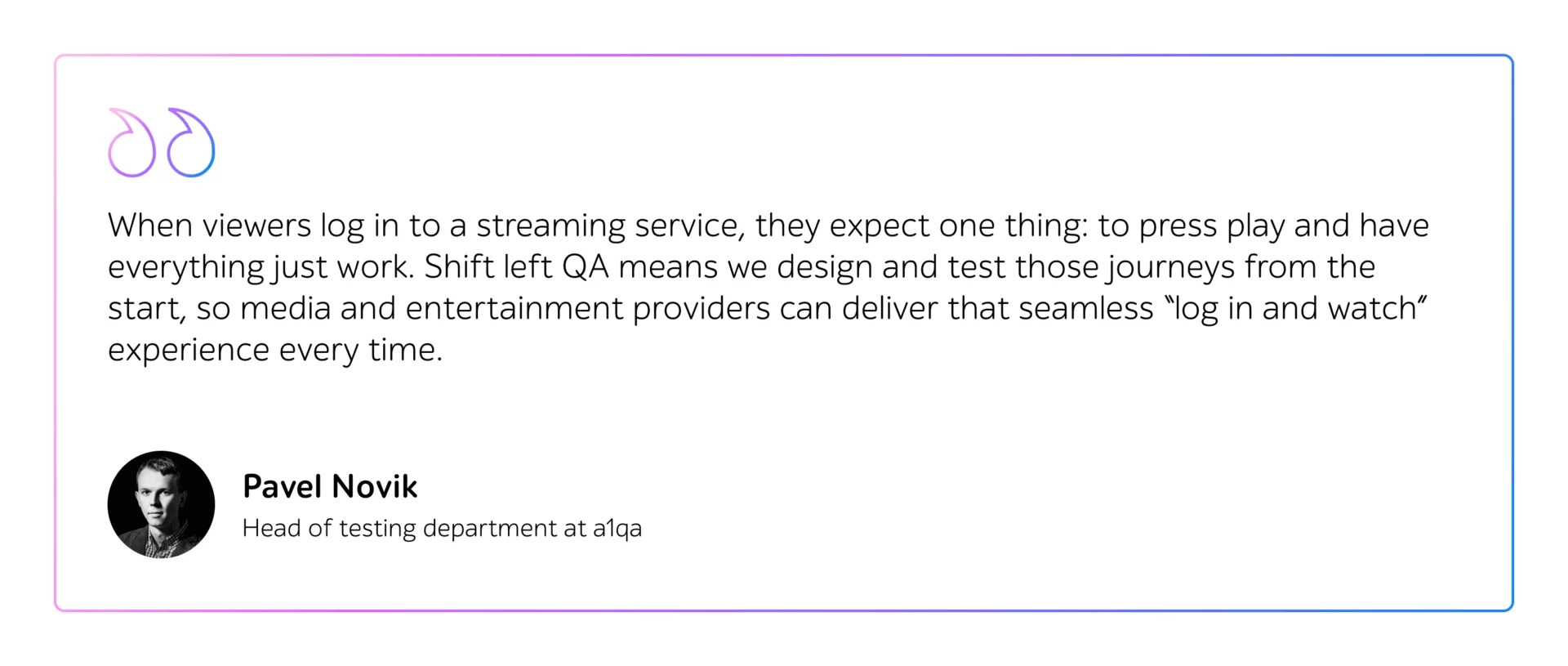
Embedding QA early (shift-left) helps catch issues when they are cheapest to fix. Monitoring live environments (shift-right) helps catch real-world issues and react fast before they hit the majority of the users.
Together, they create a strong feedback loop.
- Real device testing
While emulators help during early stages, real device testing is essential for:
- True network conditions (like 3G drops, Wi-Fi fluctuations)
- Hardware-specific issues
- Authentic user experiences
Real-world validation builds confidence.
- Smart automation
Not everything can or should be automated.
Smart automation targets repetitive, high-impact tasks, such as:
- Login flows: Automating tests for user authentication processes, including sign-up, sign-in, multi-factor authentication, and social logins, to ensure secure and smooth access.
- Video playback tests: Validating that video streams load quickly, play without buffering, and maintain quality across different devices and network conditions.
- Payment system validations: Testing the entire transaction flow, from selecting a payment method to confirming the purchase, to ensure accuracy, security, and compliance with payment regulations.
- Cross-device coverage: Automating tests across a wide range of devices and configurations to ensure consistent performance and user experience on phones, tablets, desktops, and smart TVs
Meanwhile, exploratory and UX testing still benefit greatly from human testers.
Best practice: Combine automation with human insight to handle edge cases, usability challenges, and complex scenarios.
- AI-powered testing
AI helps prioritize testing efforts, identify high-risk areas, and even auto-generate tests. It makes QA more proactive rather than reactive.
Result: Higher coverage in less time.
- Chaos engineering for resilience
Instead of hoping systems never fail, companies inject controlled failures to test resilience.
Example:
- Randomly shutting down servers during a live streaming event simulation.
- Forcing API timeouts.
Finding weaknesses early helps teams build truly robust systems.
- Building QA and DevOps collaboration
QA is no longer a separate function. In top-performing M&E organizations, testers, developers, and ops teams collaborate daily.
- Shared metrics
- Common goals
- Faster issue resolution
Building loyalty through quality
In today’s M&E landscape, users have endless choices. Switching to a competitor is easy and instant if an app, game, or service underperforms.
Software quality isn’t just a technical achievement anymore. It’s a brand promise.
Companies that invest in smarter, faster, and more resilient QA strategies will be the ones who retain loyal users, build strong reputations, and lead the future of entertainment.
At a1qa, we bring over two decades of expertise to help Media and Entertainment companies deliver flawless digital experiences.
Whether you’re launching a new platform, scaling to millions of users, or aiming to build trust through quality, we’re ready to help.
Let’s make your next release your best one yet. Contact us