
When every vendor passes but the product still fails

A scenario that might be familiar to you: your platform change was conducted by multiple third-part vendors and it reaches production. Every supplier passed its own checks, yet the customer’s journey failed.
Why?
Because nobody tested the full chain.
The challenge is to govern the service as one product, even when several companies build, test, and operate its parts.
This article explains how multi-vendor QA governance can connect supplier commitments to the full user journey, help trace changes and evidence across the company, and highlight risks earlier using targeted automation and metrics.
Give the whole service an owner
Supplier SLAs are useful but usually measure individual responsibilities. One provider may report application availability, another successful log-ins, and another integration performance. All three can meet targets while customers struggle to complete a payment, claim, booking, or account change. From an end-user perspective, the service has failed regardless of which supplier met its contractual obligations.
A product-level service goal, supported by a unified SLA/SLO matrix, gives teams a common measure of whether the complete journey works.
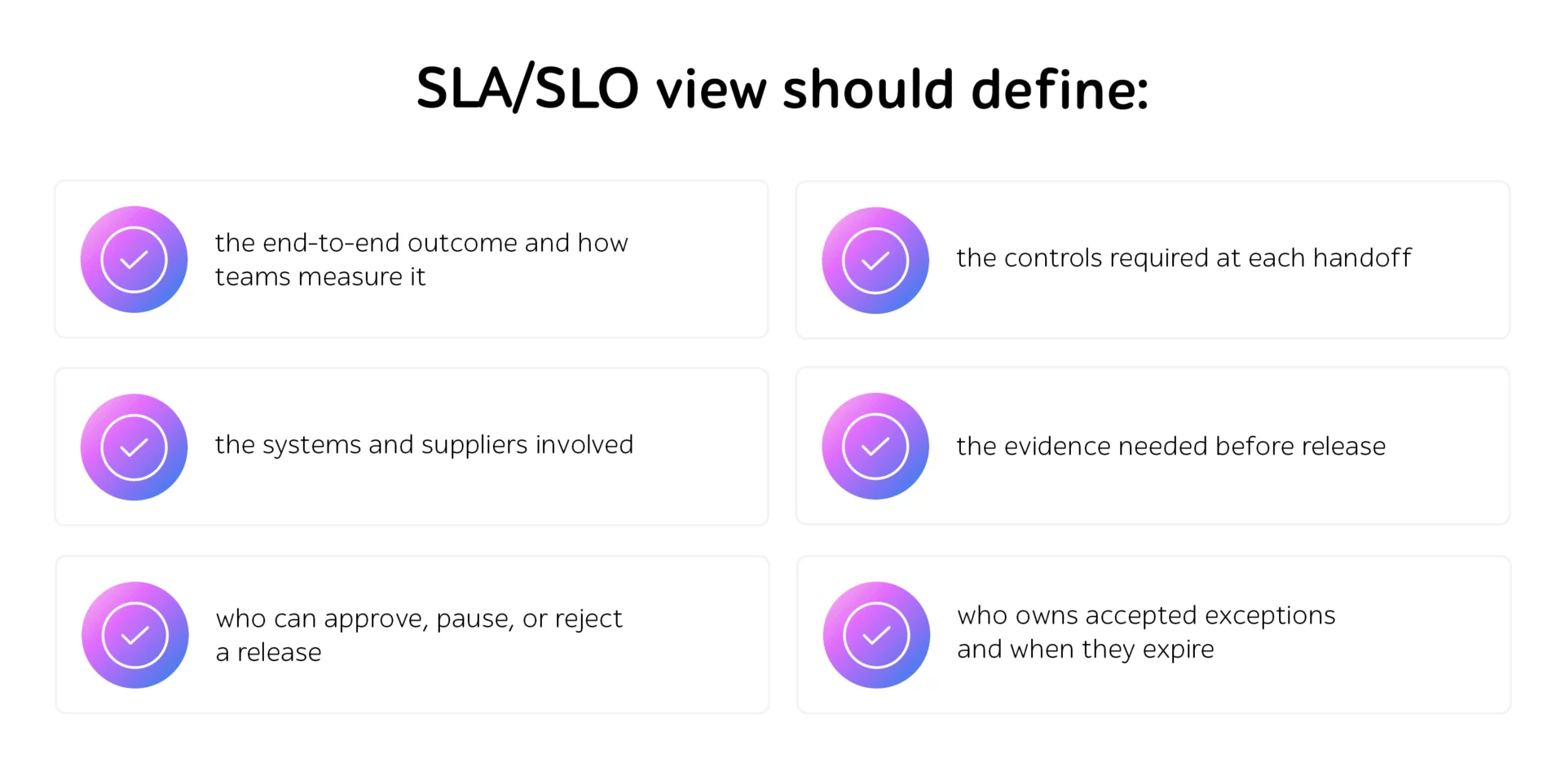
The client also needs a named owner for the overall service. That person should have authority to stop a release when the available evidence does not support it.
Commercial agreements matter here too. Contracts should cover compatibility testing, shared test data, incident investigations, and work from interface changes. Otherwise, suppliers have little incentive to take responsibility beyond their agreed scope.
Make evidence traceable across vendors
Cross-vendor incidents often expose a simple problem: teams cannot quickly connect their records. One supplier uses a ticket number, another a request ID, and an integrator a pipeline run.
Forcing every supplier into one tool is usually unnecessary. Teams can agree on a small set of shared IDs instead.
Each important change can include a journey ID, release ID, interface version, affected services, test result, approver, and exception status. A correlation ID can also follow a transaction through connected systems.
An evidence repository can act as an index. It can point to logs, test results, approvals, and other records held in existing supplier systems. This gives the service owner a traceable release history and makes it easier to reconstruct an audit trail without requiring vendors to expose proprietary assets unnecessarily.
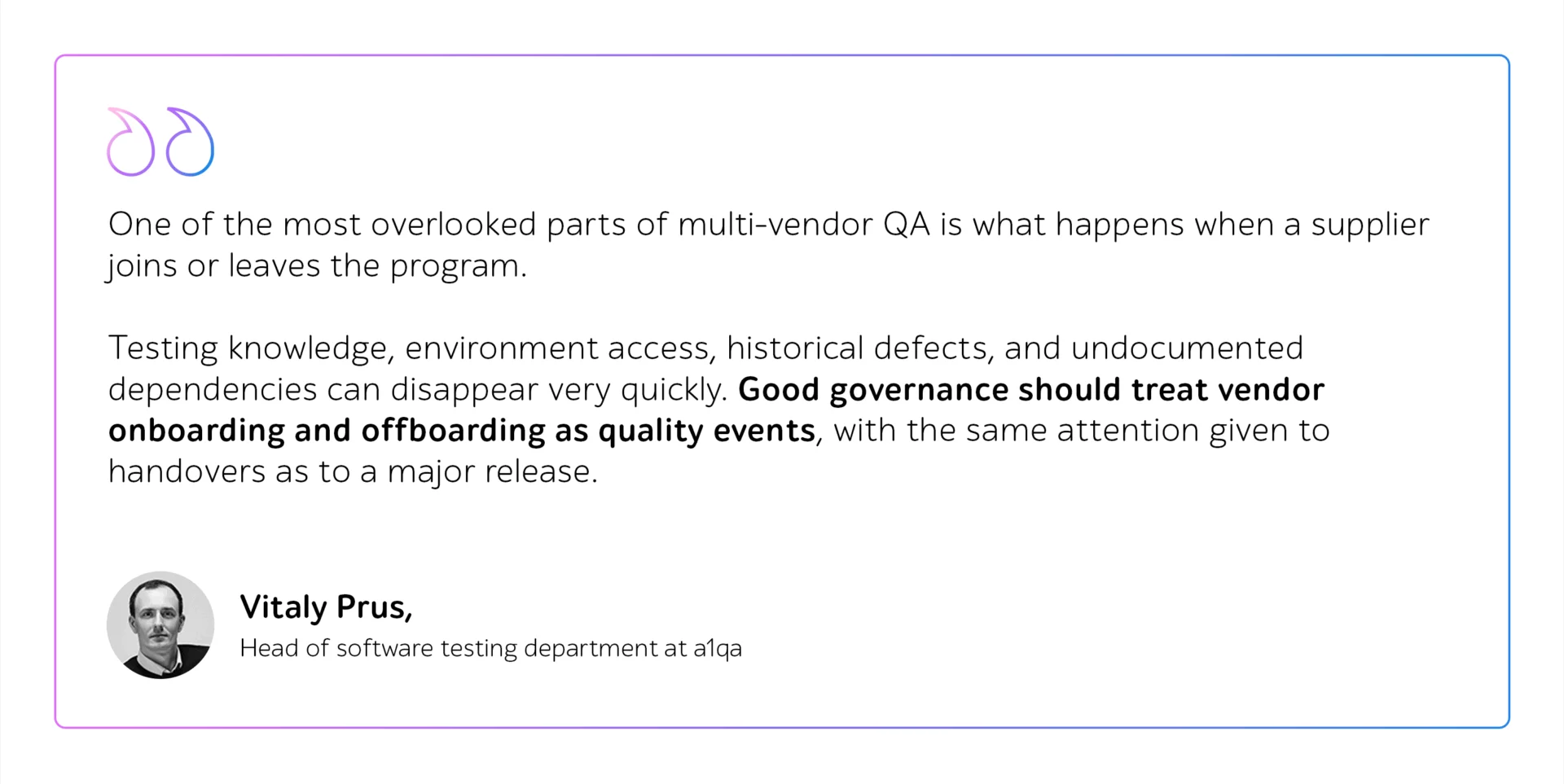
The operating model matters as much as the tooling. Teams may work across time zones, languages, severity models, and escalation processes. Written incident procedures, named contacts, overlapping handovers, and joint exercises help manage those differences. Independent QA can also review higher-risk releases, question missing evidence, and flag unresolved issues. In one a1qa case study, 87 specialists worked across four dedicated QA teams, supported by process and technical audits.
Track risks across supplier boundaries
Defects often escape when each vendor validates its own component, but nobody checks how components behave together. A component test may pass while a changed interface breaks a downstream payment or account update. Compatibility, integration, or end-to-end coverage may be incomplete.
Governance should define who owns cross-system testing, who supplies the environment and data, and who acts when required evidence is missing.
Security weaknesses can spread across vendors too. One supplier may expose a credential or a vulnerable component still in use elsewhere. Controls should identify the asset owner, affected systems, disclosure route, remediation deadline, and evidence of closure. A risk score can help teams prioritize attention.
Where personal data is used in shared test environments, GDPR requirements can shape access, data minimization, retention, and responsibilities between suppliers.
Useful inputs include:
- journey criticality and data sensitivity
- regulatory exposure
- reliance on subcontractors
- repeat incidents
- recovery time
- overdue remediation
- missing or late evidence
Some issues should trigger a hard stop regardless of the overall score.
Regulation can create additional work. For example, The Digital Operational Resilience Act sets rules for ICT risk in the EU financial sector and includes oversight of critical third-party providers.
The EU AI Act also follows staged implementation, with requirements depending on the type of system and the organization’s role.
Compliance needs will vary, but the governance question stays practical: can the organization show which suppliers were involved, what risks were assessed, what evidence was reviewed, and who approved the decision?
Use AI where it can reduce manual work
AI can help teams process information from several suppliers, provided the underlying data is consistent. It works best when teams already agree on shared identifiers, evidence requirements, and release criteria.
Predictive models can rank releases using factors like change size, interface changes, failed tests, and previous production defects. Teams should back-test the model and track missed failures and false alarms. Vendor scores need context because suppliers may record and classify data differently.
QA agents can go further. An agent could review a change, identify affected systems, trigger approved regression tests in several pipelines, and flag missing results. Adapters normalize events from different CI/CD tools without forcing vendors to replace existing platforms.
A sensible rollout starts with observation. The agent recommends actions while people retain control. As performance becomes measurable, teams can allow it to complete selected tasks.
Controls remain important. Agents should use limited credentials, record activities, and support human override. The NIST AI Risk Management Framework provides guidance for managing AI risks, including governance, monitoring, defined responsibilities, and human oversight.
Build metrics around decisions
A multi-vendor dashboard should help teams decide whether to release, investigate, or hold a change. It can combine pre-release evidence with live service signals.
Useful measures include:
- Supplier SLA adherence: commitments fulfilled divided by commitments assessed.
- Critical-journey SLO: successful end-to-end journeys divided by valid attempts.
- Defects per vendor: confirmed defects per accepted change, release, or another agreed unit.
- Vendor-attributed defect leakage: assigned defects that escape the agreed testing stage and reach integration or production.
- Integration stability index: critical-path tests passed divided by tests run in the release environment.
- Cross-vendor restoration time: the time between issue detection and service restoration.
Teams should compare similar work and allow shared defect attribution when multiple controls contributed to an escape.
Teams should keep test results separate from live service performance. A release can pass every planned test and still cause customer problems.
Close the gaps before the next release
Fixing an individual defect restores the immediate service, but governance should prevent the same type of gap from appearing elsewhere. Before the next release, teams should know who owns the customer journey, which cross-vendor tests are required, where to find evidence, which risks remain open, and who makes the final release decision.
AI can help surface missing results and higher-risk changes. Clear ownership determines what happens next.
If supplier dashboards keep showing green while integration problems reach production, a1qa’s multi-vendor QA specialists can assess testing responsibilities, vendor interactions, reporting, dependencies, and quality controls across the delivery model.