QA vs QE: How to transition to quality engineering in the age of AI

Most software quality failures we encounter aren’t caused by bad engineering. They’re caused by a model that was designed for a slower, simpler era of delivery. Traditional QA was built to catch defects before release. Quality engineering is built for a world where release is continuous, and defects have business consequences that compound by the hour.
That’s why in this article, we explore why QA is evolving into QE, the role of AI in this transformation, and how organizations can successfully make the shift.
Grasping the nature of the evolution process: What is quality engineering?
Quality engineering is an approach that embeds quality across the entire software development lifecycle by focusing on prevention, automation, and continuous validation.
QE teams work closely with developers from day one, including prototyping and requirements phases. By leveraging a shift-left testing approach, they shape architecture for testability, design IT products with quality in mind, find flaws early, while growing test automation and observing software behavior to guide the next sprint.
Quality engineering extends DevOps by embedding continuous testing into every stage of delivery.
Why QA is no longer enough
The shift toward QE reflects broader changes in how software is built and delivered:
- Systems are becoming more complex
- Release cycles are accelerating
- AI introduces non-deterministic behavior.
This approach is currently gaining momentum. One market estimate puts the quality engineering market at $99.94 billion by 2031. The World Quality Report 2025-26 also shows how widely these practices are spreading: only 3% of respondents said they had no dedicated quality engineers on agile projects, and just 2% said GenAI was unlikely to become part of their testing workflows.
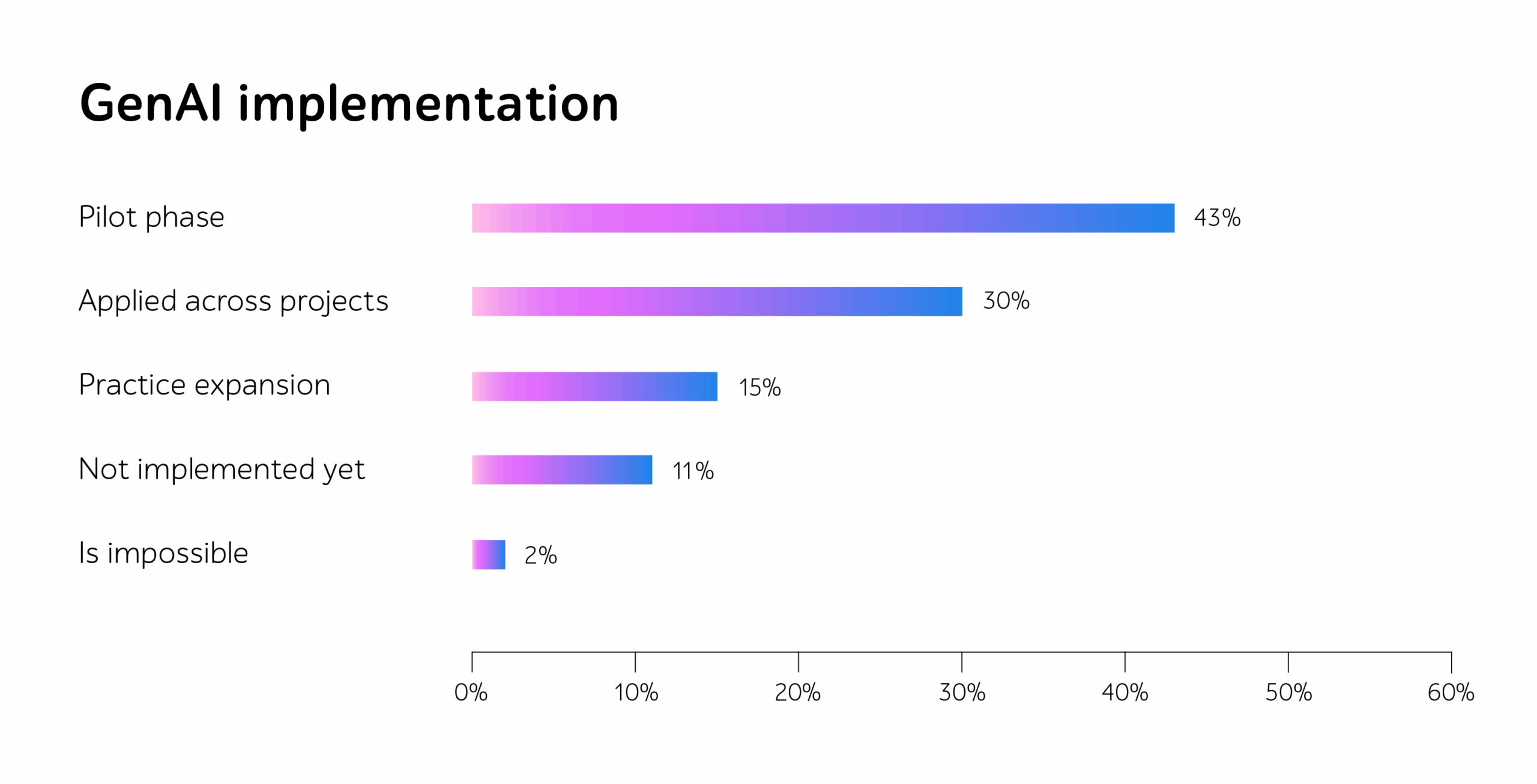
Source: The World Quality Report 2025-26
Benefits of quality engineering
The shift to quality engineering also reflects a broader move toward intelligent automation. In traditional QA models, testing often requires a lot of time and effort, involving human intervention to a large extent. Quality engineering, in turn, relies heavily on automated tools, but its real strength comes from smart technology.
AI helps by creating test scenarios, spotting risky code, and predicting where defects might hide. It’s also useful for generating data, reviewing code of test automation, creating automated scripts, and integrating them into CI/CD pipelines.
Continuous delivery systems run these checks constantly to give programmers instant updates.
Meanwhile, cloud enables scalable automated testing by providing access to on-demand environments and real-device farms. This allows running large volumes of tests in parallel, validating cloud infrastructure, and simulating real-world usage under normal and peak conditions with minimal manual effort.
This combination makes quality proactive, dynamic, and helps organizations derive the following benefits:
Boosted release velocity
Quality engineering weaves testing into every single step of the SDLC. Rather than checking for mistakes at the very last second before release, project teams identify and fix defects as they appear. This stops unexpected delays, speeds up the launch process, and increases overall confidence in the new IT products’ features.
For example, by implementing test automation and integrating it into scheduled DevOps pipelines, a construction firm that relied on Salesforce for core business processes managed to save 2,500+ hours of manual work and decrease the amount of defect rates at the UAT stage by 33 times.
Lowered operational expenditure
Catching errors early saves significant money, as the cost of fixing skyrockets once software reaches the production environment. Quality engineering focuses on preventing mistakes to find risks sooner and avoid the heavy price of late-stage rework, ensuring that budgets are spent on building new features rather than fixing old problems.
To illustrate, an AI-driven test automation introduction helped the developer of a digital platform for spreading multimedia content reduce QA costs due to a 4x speed-up in testing time.
Unrivalled scalability
Big systems are naturally harder to manage, and traditional testing may fail to catch how software reacts to heavy traffic. Quality engineering fixes this by ensuring the entire system stays strong as it grows rather than just checks if a feature works. This way organizations can expand their services smoothly and keep everything running perfectly for every new customer.
AI-powered test automation as a cornerstone of QE
In AI-driven systems, testing is no longer a phase, it is a continuous capability.
Previously, automated workflows were primarily used to execute predefined test scripts faster. While this significantly improved efficiency, the approach still relied heavily on human input for test design, maintenance, and validation of AI-generated results.
In practice, AI transforms testing across three layers:
- Generation — creating test cases based on system behavior and user interaction patterns
- Prediction — identifying high-risk areas and potential defects
- Adaptation — enabling self-healing and continuous optimization of test suites.
Together, these capabilities shift testing from a reactive activity to a predictive and adaptive system.
AI agents now introduce intelligence at every stage of the testing process:
- AI-driven test generation helps teams test much more than they ever could by hand. By looking at how IT solutions work and how people use them, agents build tests that mimic real-life habits. They also integrate these tests directly into CI/CD pipelines, ensuring continuous validation so every check is not just thorough, but actually useful for the end user.
- Predictive analytics shifts teams from fixing old breaks to stopping new ones. By studying past defects and system updates, AI pinpoints high-risk zones so developers can focus their energy where it matters most. No wonder that 57% of Gartner Insights respondents believe that Gen AI will significantly improve defect prediction in the next three years.
- Self-healing solves the biggest headache in tech: constant upkeep. Instead of humans manually repairing broken or outdated tests, agents update themselves on the fly, keeping everything running smoothly without any downtime.
- Code review of the automated tests becomes faster and more accurate with AI agents identifying gaps in coverage, redundant logic, and targeted improvements for increasing overall reliability.
Importance of smart leadership when transitioning to QE
QE spans the entire SDLC, from development and product management to operations and customer experience. That’s why in addition to high technical proficiency of all team members, it needs a lean oversight strategy that guarantees that project teams are kept focused on the same goals and simultaneously cuts out bureaucracy that may slow everything down.
We recommend focusing on the following vital pillars:
Governance
Leadership should create a framework outlining who is in charge of quality and what they need to do. This involves picking standards and getting everyone on the same page. Solid oversight ensures that quality is a core part of the business plan. Without it, even advanced quality practices may end up being ineffective.
Metrics
It’s vital for managers to leverage key performance indicators to focus on real results, like how well an application runs or how steady updates are. These metrics should be easy to understand, tracked consistently, and reviewed alongside operational and business data. When success is measured by what the business actually cares about, it’s easier to ensure smart prioritization and keep everyone responsible.
Culture
Organizations that treat quality as a shared responsibility outperform those that silo it.
They should align goals and rewards with quality outcomes, encourage fast thinking, and trust specialists to manage their own outcomes. Although changing how people think takes effort, it’s the only way to ensure that quality practices are fully embraced.
How to transition from QA to QE: Steps to navigate a complex transformational journey
It goes without saying that many organizations understand the importance of QE, but struggle with the transition process. But nothing is impossible.
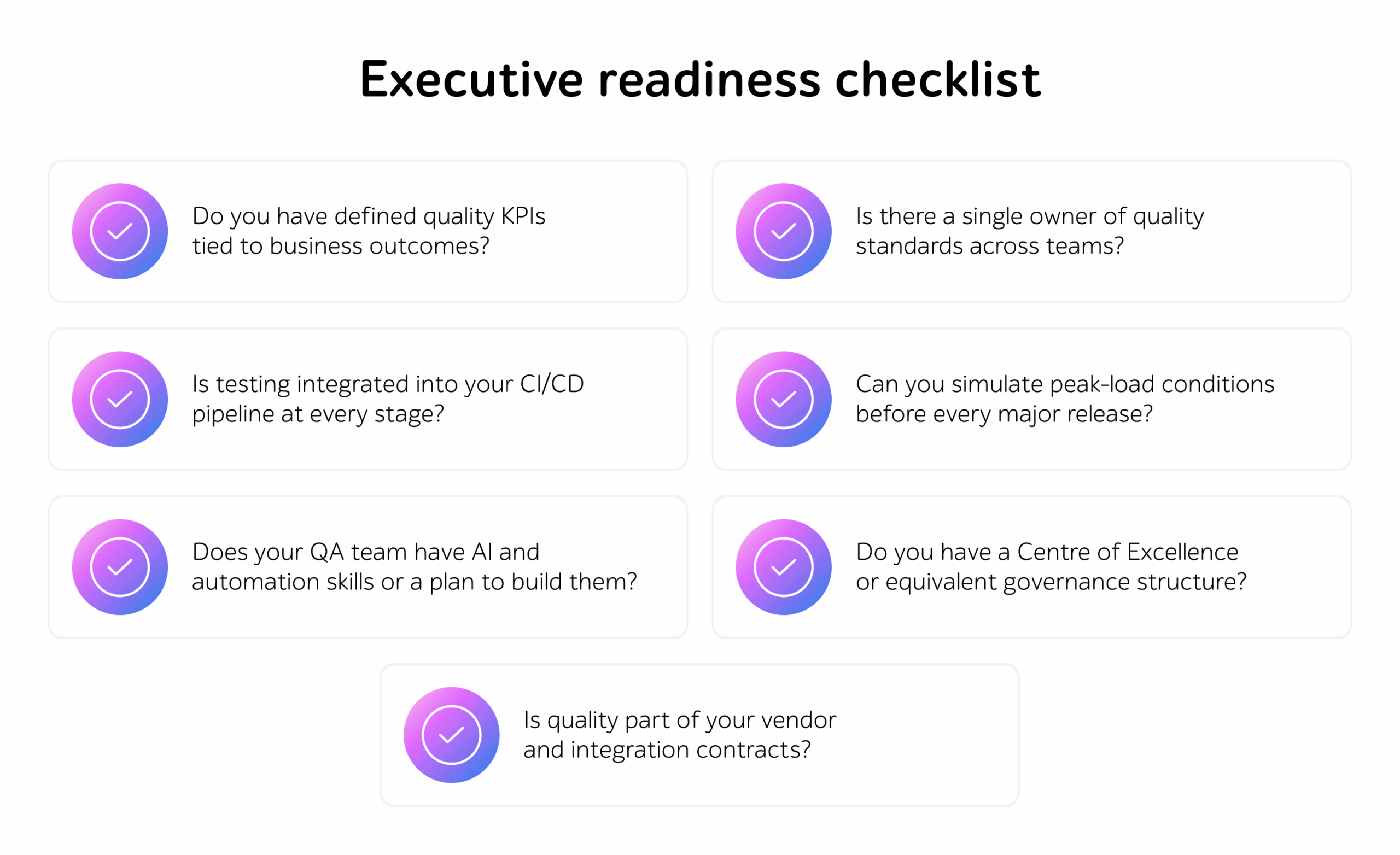
To increase the odds of success, companies may consider steps that guide practical implementation:
Step #1. Assessment
A successful transition starts with an honest assessment of current tools, processes, and skills, so gaps can be identified early and investment can be directed where it matters. This ensures that as a company’s standards rise, its day-to-day operations remain rock-solid.
Step #2. Execution
While introducing new practices, strengthening test automation, and developing skills required to support a more advanced quality approach, companies should focus on equipping teams with the tools, knowledge, and processes needed to move beyond traditional testing. This drives greater consistency in how quality practices are implemented across the organization.
Step #3. Continuity
Teams should weave quality into the entire SDLC to ensure validation remains a constant process. Due to integrating continuous testing and monitoring directly into the workflows, one can create a self-correcting loop of feedback, allowing for rapid defect detection, high flexibility, and software stability. And statistics prove this fact. Integrating continuous testing is now a priority for 65% of firms looking to accelerate release cycles without compromising system integrity.
Step #4. Standardization
Scaling quality engineering requires a central hub, a CoE, to anchor the entire enterprise. This establishes the governance and standards needed to keep quality efforts uniform rather than fragmented. By uniting tools and accountability under one umbrella, an organization can move seamlessly toward shared goals. This transforms quality from a localized task into a permanent capability that drives sustainable business efficiency.
“Change is the only constant”
Within the next two to three years, the architecture of quality will look fundamentally different. Autonomous QA agents will operate continuously across environments, detecting anomalies, updating test suites, and flagging risk without waiting for a human to trigger a test run. AI-generated coverage reports will replace manual test plans as the primary artifact of quality assurance. And quality SLAs, today largely informal, will become contractual: built into SaaS agreements, integration contracts, and enterprise procurement requirements.
Organizations that treat this as a distant possibility are already making a strategic error. The infrastructure decisions, skill investments, and governance models required to operate at that level take 18 to 24 months to mature. The window to build proactively is now.
If you’re evaluating where your organization stands, a1qa’s specialists can give you a clear picture of the gaps and a realistic path forward. Reach out to get a free consultation.