

Telecom software testing
We help telecom companies bring solutions equipped with 5G, IoT, cloud networks, NaaS, and AI technologies to market faster and more safely through comprehensive testing and quality assurance. Telecom software testing ensures the systems meet all the voice, data, and video communication requirements while delivering a seamless experience to end users. Thus, our QA specialists help prevent service disruptions and ensure stable, high-quality network performance, which is critical for telecom operators.
Our service offer includes ensuring the quality of various telecom systems such as OSS/BSS, resource inventory software, document, and reporting solutions, as well as performing VoIP and IVR testing, service activation testing, and security checks to validate the protection of subscriber data and business solutions’ consistent performance and reliability. We also test complex 5G scenarios, including handover processes, device compatibility, and load handling on next-generation network cores.
With deep expertise in key industry trends, we assist wireless, mobile, and fixed communications providers and software integration and development companies in combining strong QA practices with a deep understanding of telecom business processes, enabling business growth and providing the impeccable operation of mobile networks in the competitive telecom sector.

Telecom software systems we test


Trusted by global telecom enterprises
We offer diverse types of testing for your telecom software
a1qa is there to help you perform any telecommunication industry proficiency testing activities without service outages or security breaches, as well as ensure boosted telecommunication network capacity and broadband connectivity.

QA consulting and analysis
To refine a QA strategy and processes held in companies or embed them, we audit QA processes for telecom integrators and service providers and consult on migration testing, Parallel/Dry Run techniques, UAT, smoke testing, system tests, approaches for performance testing, test automation. We also submit recommendations for implementing improvements.

Acceptance testing
To provide a flawless experience for end users, we run acceptance tests for new and updated billing systems, CRM and ERP solutions, contact and call centers, document and reporting systems, etc., and evaluate their quality. Afterward, we make a final determination on accepting them into the production environment, depending on the obtained test results.
OSS/BSS testing
To ensure that the most critical functions, such as billing, payments, service activation, bandwidth management, etc., operate correctly and in compliance with requirements, we perform end-to-end service verification.

Regression testing
To make sure that the recent code changes haven’t negatively affected the well-working functionality and eliminate accumulated technical debt, we help you introduce regression testing at the early SDLC stages through test automation and functional testing.

Security testing
To safeguard subscriber bases, sensitive information they possess, OSS/BSS, and similar systems for storing data from internal and external cyber threats, we infuse the best DevSecOps practices. a1qa also offers penetration testing, vulnerability assessment, static code analysis, and more.

Performance testing
To ensure that systems respond to numerous requests from subscribers and to make sure that billing, CRMs, other critical parts responsible for providing telecom services can receive and quickly process them, we carry out diverse client- and/or server-side verifications, be it stress or load testing.
For example, a1qa helped a large telecom operator ensure its new billing platform would be able to withstand the load that previously was distributed between 25 systems.

Migration testing
To ensure the full migration of data to a new OSS/BSS, the response time of the target software is the same or less, and novel systems and data in them comply with requirements, we apply Parallel and Dry Run methods during migration testing.

Cloud testing
To eliminate weak points, simplify testing processes, and boost scalability, we assess cloud infrastructure, including virtual elements such as NFV/SDN, any cloud-driven telecom solution, e.g., hyper-converged infrastructure (HCI), and data centers.

Mobile app testing
To deliver flawless UX across diverse devices, we validate mobile applications for self-service purposes such as checking subscription and balance status, making payments, messaging operators/users, and extra apps provided by telecom companies, e.g., streaming services. The usage of 300+ a1qa’s in-house items increases testing accuracy and helps spot more issues specific to mobile hardware and OSs.

Integration testing
To establish successful interoperability of OSS/BSS, real-time interaction of integrated telecom software components such as billing systems, CRMs, other parts of telecom solutions, and unhindered data transfer between them, we test them as a unity applying a big bang, top-down, bottom-up, or hybrid strategy.

Functional testing
To enable stable software operation and identify critical issues before going live, we’re able to join the project at any SDLC stage. We create test approaches, test plans, test scenarios, and test cases and perform manual testing of diverse telecom solutions — from convergent billing and self-service systems to resource inventory solutions and integration platforms.

Compatibility testing
To provide consistently equal software operation and cater to the demands of target audiences, we check mobile and web applications, self-service systems, solutions for working with tariffs and subscriptions, and functionality of call center applications across different browsers, platforms, and OSs.

Test automation lifecycle to deliver top-tier software faster
With automated testing of regression activities, we decrease costs, enlarge test coverage, minimize human error risks, eliminate technical debt, and meet quality gates.
We employ an effective toolkit, including Selenium, Appium, Playwright, and in-house Aquality Automation framework developed at our R&D test automation center to streamline the process. The solution:
- Supports programming languages such as Java, C#, JS, and Python
- Enables smooth test development for web, mobile, and desktop product types
- Ensures top-rated scalability and visualizes test results
- Leverages AI elements to provide smart bug pre-submission and define the root cause of test failures.
a1qa’s tailored test automation approach helped the developer of AI-powered cloud contact center software successfully eliminate technical debt consisting of 3,000 voluminous test cases and minimize business risks.
a1qa helped a distributor of telecom solutions for service providers and telecom operators transition to early-cycle test automation, create new tests, and streamline their automation framework to reduce code volume by 3 times while taking ownership of test scenario preparation.
a1qa implemented a test automation and DevOps strategy for a trade body in representing the interests of MNO, which included automating SDK and API testing, containerizing the environment with Docker, and developing a centralized tracing portal, reducing testing time for new apps from 40 hours to just 2.

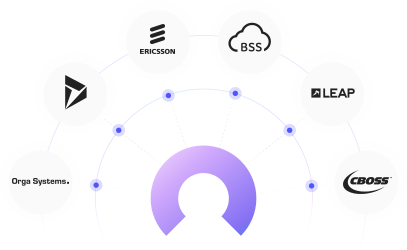
Ever-growing set of telecom testing tools
- BSS/OSS by Orga Systems
- Microsoft Dynamics 365 by Microsoft
- BSCS iX by Ericsson
- Digital BSS by Ericsson
- Leap Billing by FTS
- OSS/BSS by CBOSS
Shift-left testing to drive quality on a consistent basis
We shift testing left to speed up the release pace, detect issues at the earliest development stages, and reduce testing costs. How does it work?
- Continuous and quick feedback
- Enhanced customer experience
- Cost-effective QA processes
- Accelerated time to market
- Improved software quality
- High resistance to cybersecurity threats





When do you need independent QA?

Complex digital transformations
Can you perform transformations without compromising software quality and successfully overcome challenges related to software, devices, system interactions, and provisioning?

Lack of domain-specific expertise
Do you have to spend extensive time and money resources on constant education of internal teams to reach set goals and highest industry standards?

Overloaded working processes
Do you confront postponed deadlines, a decrease in the quality of work, unnecessary extra activities, and a frazzled squad due to low team capacity and overladen workflows?

Poor team productivity
Do you struggle to grow your business due to delays in project timelines, increased operational costs, and reduced profitability caused by low team performance?

Inaccurate project estimations
Do you often face release schedule delays, lost profit, and a demotivated team under constant pressure — all due to the shortage of best practices when planning project costs?

Limited test coverage
Is it challenging for you to provide a flawless user experience because of multiple issues in the production environment?
Shortage of test automation in place
Is it complicated for you to validate end-to-end business flows and maintain high software quality because of long testing cycles, human error risks, and poor test coverage?

Unoptimized budget
Do you overspend but attain little progress due to performing unsuitable checks and hesitating about which toolkits, technologies, and approaches to use to set up QA practices?

Why a1qa?

20 years of experience
We’ve successfully completed telecom projects for clients across 39 countries, so we’ve already figured out what QA approaches work best for validating software quality.

Ongoing training
We continuously educate QA engineers in the internal a1qa Academy to sharpen their skills.

Team scalability
We briskly ramp the team up or down to cope with changing project workflows.

Niche expertise
With 100+ successfully performed telecom projects, we can smoothly solve any industry-related testing challenges.

Operational benefits
We don’t just test. We help our clients expedite time to market up to 10 times.

Improvement of QA processes
We develop an in-house CoE for telecom to provide best practices, research, and training to increase testing efficiency.
Frequently asked questions
Telecom QA services include functional testing, performance and security testing, compatibility checks, test automation, cloud testing, regression testing, and telecom regulatory compliance testing. These are applied to systems like OSS/BSS, CRM, ERP, mobile apps, call center software, and SDN/NFV networks to verify their reliability, regulatory compliance, and certification readiness.
QA consulting for telecom includes auditing existing testing processes, advising on test strategy improvements, and assisting with specialized methods like migration testing, UAT, smoke testing, and performance testing. QA providers can also help define test automation approaches and offer guidance on enhancing QA efficiency and ensure software and equipment readiness quicker.
Test automation accelerates regression testing process, increases test coverage, and reduces human error risks. It also helps eliminate technical debt, streamline validation for new releases, and speed up time to market. Tools like Selenium, Appium, Playwright, and a custom in-house automation framework are used to support web, mobile, and desktop telecom solutions with smart defect detection and scalable execution.
Shift-left testing in telecom involves starting quality assurance activities at the earliest stages of the project’s development, including during the requirements definition phase. Testers begin designing test cases early and continue testing throughout the entire SDLC. This approach helps detect defects sooner, speed up release cycles, improve software quality, and reduce testing costs.