
How to arrange fruitful joint work with an outsourcing QA team

In line with a highly competitive market, businesses have their eye on digital experts to effectively promote their brand, turn to programmers and QA specialists to deliver a top-notch application under tight deadlines.
Cooperating with QA vendors, organizations not only get an experienced team, but also reap numerous benefits: concentrate on core activities, optimize costs, increase operational efficiency, and much more.
However, besides brought success, it shares potential risks and responsibility for achieving goals in delivering flawless software.
The process of choosing an entrusted partner is difficult, even when you have a solid plan for further activities. In this article, I will share tips on how to pick an infallible QA provider and how to start this prosperous cooperation.
Is it worth onboarding the distance working team?
Every organization possessing an IT solution asks the same question. “Should we hire in-house QA engineers and provide hands-on technical training, or transfer tasks to an outsourcing team that integrates into the process and delves into the software hallmarks?” There is no right answer, as it all depends on the peculiar requests of a company.
- If it aims to nurture an internal department, the decision will be made in favor of its in-house team.
- If the goal is to reduce costs on creating and maintaining a novel direction, it will turn to an independent vendor.
Collaboration with a QA provider brings a formed group of specialists that are selected according to business needs. Therefore, it saves costs and time on human resources.
Outsourcing a dedicated team allows setting non-key processes (like software testing for a bank, for instance). Also, QA specialists’ commitment and narrow-focused competence push the envelope to new initiatives.
Since the organization has an IT solution, its development process divides into cycles and workload distribution is likely to be unbalanced. Sometimes QA engineers have to wait for the next build so that they stay out of work. After a while, they are overwhelmed with tasks and run out of time to perform all the necessary tests. Outsourcing helps companies flexibly control the amount of work and onboard specialists on demand.
Moreover, even if you are confident in your software product, occasionally it needs an independent assessment to identify the shortcomings and improve quality.
Selecting a QA vendor
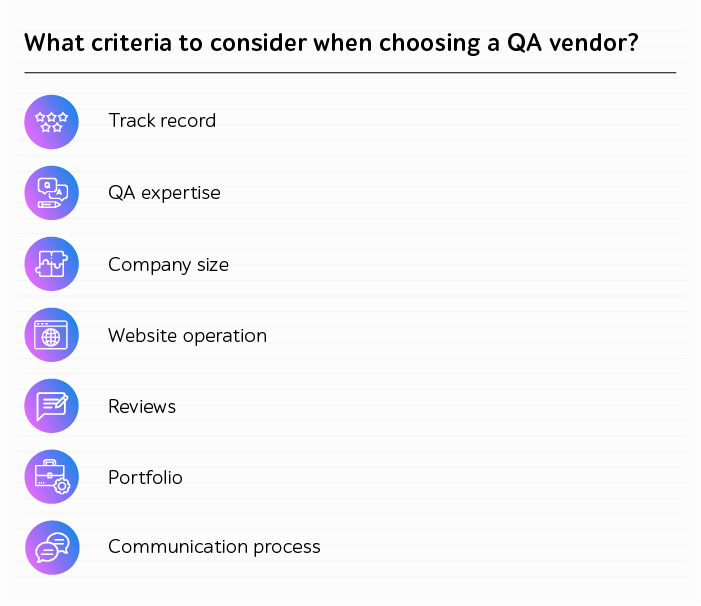
The provider’s investigation lays in the heart of the successful partnership. Try to figure out all the necessary information. It might be the size of a company, its market experience, portfolio, and much more.
What is more important, pay attention to the official website. It is rather unreliable to trust a company, which can’t establish a satisfactory operation of its own digital space, right?
You may also have a look at the reviews from its previous clients on the independent platforms, like Clutch. It helps form a more comprehensive picture of the vendor.
Don’t forget about a portfolio. There you can find success stories from diverse spheres and make sure that the organization has experience in similar projects.
Many outsourcing companies also offer pilot projects so that a team demonstrates its skills in practice. It is the most suitable option for clients to check flexibility and team scaling on demand to assess the results and decide on further cooperation.
Integrating the outsourcing QA team
Once a company has chosen a QA provider, the next step is to think over a team integration in the current project infrastructure. Continuous communication is a silver bullet. It might be more effective to use shared online tools: file storage, messengers, video conferencing platforms, etc.
Identifying the responsibilities of each member helps everyone know what to do and whom they can contact in case of an emergency. To synchronize processes, regular meetings can be established.
Knowledge transfer is one of the keys to business success. However, many companies do not have a clear plan and holistic insight into it. a1qa’s experts suggest the following algorithm at the start of cooperation:
- Compose a plan. The order of joint actions should describe the business process that is delegated to a remote team. So, you can detect potentially vulnerable areas that need close attention from the side of a QA provider.
- Ensure minimal impact on business-critical operations. Knowledge transfer shouldn’t disrupt business activity. If a company shifts the responsibility of a process to an outsourcing team, then in-house specialists should be fully involved in their core charge.
How to provide efficient communication
Both customer-company and vendor-organization should work together and find an optimal cooperation format. Members can communicate in a real-time mode, every day, every two weeks, once a month, or less frequently.
Accustomed platforms and messengers are suitable for solving simple or non-urgent tasks. It is convenient to keep in touch with each other within one or two tools when all the information is concentrated in one storage. Such communication can be supplemented by weekly or short daily calls.
Retrospectives summarizing interim results mark the end of each sprint in Scrum. The client’s dedication helps form a clear vision of current priorities, and the team receives timely feedback.
When leveraging Scrum or SAFe, companies should adhere to the following principles:
- Incrementally plan participants’ actions
- Maintain continuous communication
- Meet deadlines
- Scale up and down the team on demand.
Scrum planning can take a few hours, while the cycle in SAFe usually lasts a couple of weeks with several phases of planning, verifying, and configuring.
Unlike high-level team consistency in SAFe, Scrum allows multiple teams to work together at a low dependency level.
Estimating the remote team’s productivity
Before jump-start working, you should clearly understand your project business goals, while by tracking KPIs, you can see met targets, realization stages, and remaining tasks to derive the valuable outcome.
Testing equipment also makes a difference. For example, mobile app testing requires real devices to simulate end users’ actions.
Partnership with the outsourcing team: core concepts
Shared stake in success with delegated responsibility is the cornerstone of project performance. For instance, a QA team sets such transparent processes that the client receives up-to-date information about the status of issues and new defects weekly or daily via video conferences or email. This adaptability helps build trust and mutual understanding.
Besides, many customers value QA specialists’ intent on delving deep into the business context and learning the product features.
It is great when a client provides everything required for high-quality work, maintains the relevance of information sources, and informs about any internal changes in the company.
In conditions of geographical distribution, an experienced provider adapts to the client’s time zone. Depending on their requirements and business goals, QA engineers can adjust work schedules to fit the customer’s mode.
Cooperation with a remote team is a craft where the all-important point is a joint work of a customer and a QA provider.
a1qa knows how to tweak it to perfection. If you still doubt to onboard an outsourcing team, feel free to get hold of the a1qa’s experts.