
Fintech app testing fundamentals: what still matters today
This article was originally published in 2020 and outlines the fundamentals of fintech app testing. Since then, fintech ecosystems, regulations, and risks have significantly evolved. Below, we revisit the principles that still remain relevant today and link to more recent, in-depth resources covering modern fintech challenges.
By the late 2010s, mobile and fintech applications became a primary channel for managing personal finances, raising expectations for usability, security, and uninterrupted access to financial services.
Fintech businesses aim at delivering innovation-driven products and continuously improving user journeys within financial applications.
The adoption of AI, ML, and RPA has made fintech applications more personalized and efficient, increasing user engagement and expectations for seamless digital experiences.
So, we see the power of fintech apps. However, with the financial software complexity, the more force you get, the more responsibility one should take for its development. Complexity – what are we talking about? Financial technology manages, processes, serves, and delivers vital user data that is considered to be private and sensitive (credit card info, social security numbers, etc.). As fintech ecosystems grow more complex, the impact of failures extends far beyond individual applications.
The financial industry, along with healthcare and government, is highly regulated.
Organizations working within such rigorous regulatory requirements have a higher cost of a data breach. Over time, this responsibility has only increased, as fintech apps now operate within tightly regulated and highly interconnected ecosystems.
With all that, fintech applications – be it a mobile, web, or other software types – should get special treatment of QA. To know more about quality assurance significance and which testing types we recommend each app to pass through, keep reading. Over time, regulatory requirements and expectations for operational resilience have only intensified.
Quality assurance in fintech: foundational considerations
Software defects that are seen and found by users not just irritate them, but scare that their private and financial data is under risk. Also, fintech products are diverse and can entail multiple financial areas like payment systems, lending, mobile banking, investment, and many more.
Therefore, they have to obtain a customer-centric testing strategy, which should take into consideration the following aspects:
- Data confidentiality and security of private and financial info
- Compliance with regulatory issues for financial transactions
- Transactions processing process peculiarities
- Users’ request processing speed
- Multi-level functionalities
- Accessibility to all potential users
- Hard-to-handle complex customers DB
- Multiple variations of used devices for accessing apps
- Possibilities of security threats and breaches
While giving significance to QA and software testing, companies can offer their consumers tech-oriented software products tested specifically for the selected target audience. Apart from providing error-free code, the QA engineers can help reduce efforts and budget.
For the customers that are new market-makers, the businesses can increase delivery speed, put in their hands a high-quality software, and get the improved financial experience.
Core testing areas for a basic fintech application
As with any other software product, financial technology products should pass a range of testing types. Bearing in mind their multi-tier functionality, we will get to the bottom of each check.
1. Functional testing
Testing fintech app functionalities is a huge concern, which differs a lot from classic software testing scenarios, as it includes at least work with financial transactions and sensitive data. A QA engineer should explore the app from inside out and delve really deep in the BFSI area itself. And it is logical to get that ALL possible test cases are to be envisaged covering alleged risks in the features.
To ensure the app meets the requirements, testers are also to assess the level of interactions with other systems and software components.
2. Security testing
This is the ever-evolving issue in fintech app checking while using and storing personal, financial, and banking information of the consumers. Due to third-party payment gateways and money transfers, the system becomes a garlic bread for hackers. Not to let them steal the data, testing veterans conduct pen testing allowing perform the ethical hacking when thinking as a QA engineer but acting as a violator.
This is how it becomes clear how the app reacts to cyberattacks and helps find areas of vulnerabilities or risks.
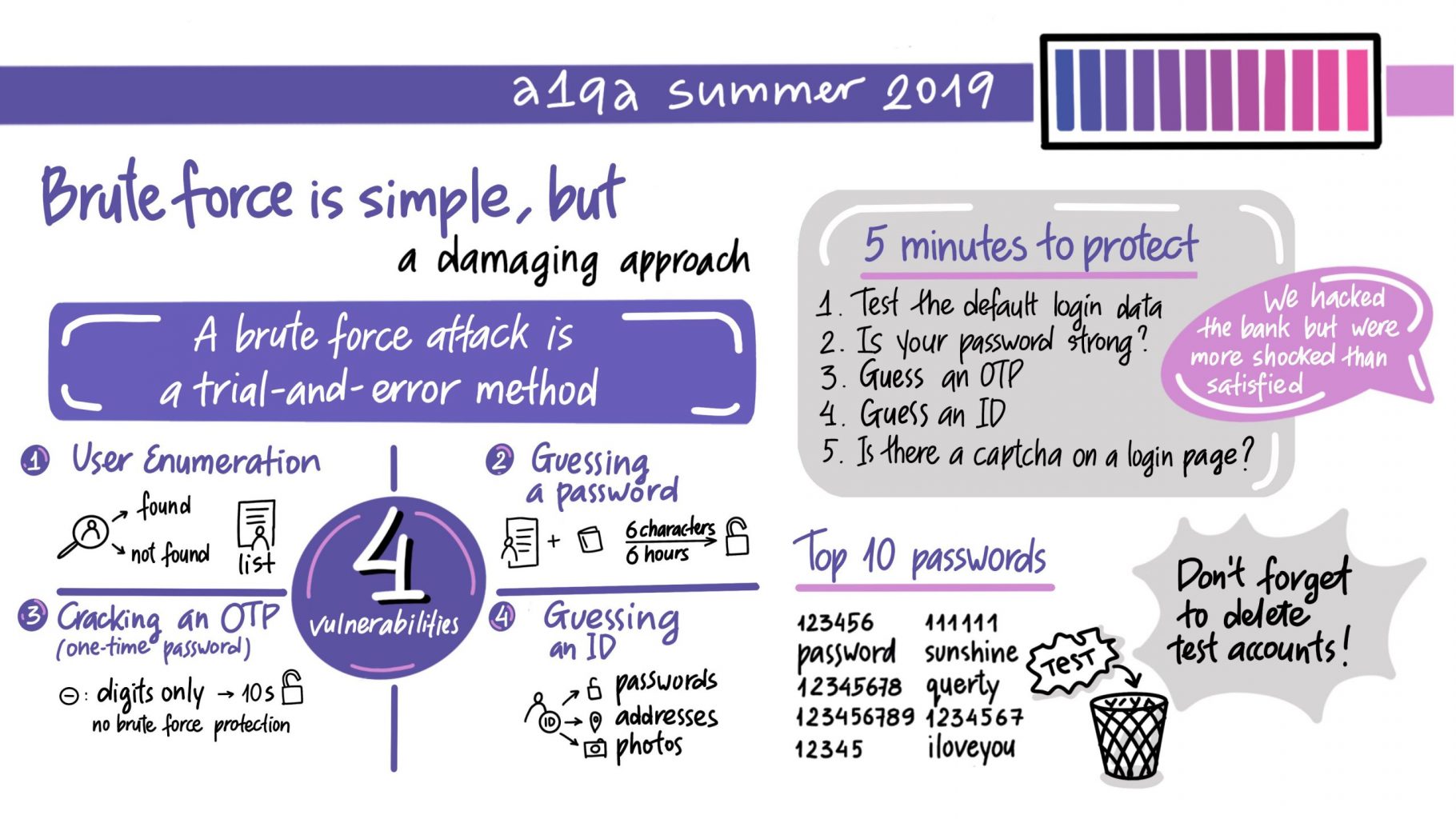
For the 9th a1qa summer professional conference, our security testing specialists prepared a presentation based on the real project. Having worked with the client’s online banking system, the experts have found some critical vulnerabilities connected with brute-force attacks. Have a look at the highlights below.
3. Data protection
Hard to imagine an industry that uses data more frequently than in financial technology. Said so, protection and managing all information is an essential question to be answered.
Databases should be tested for integrity, smooth migration, and quick loading. Creating a realistic set of data requires a holistic approach, as a tester has to always remember about the security of info.
4. Compliance checks
As a well-known fact, financial companies must work with respect to a regulated set of rules depending on the geographical or industry zone. For collecting or processing the European Union’s residents’ data, we talk about GDPR. In the United States, the CCPA (California Consumer Privacy Act) adopts the EU rules for California residents, Gramm–Leach–Bliley Act (GLBA) sets privacy and security requirements, the State data breach notification laws empowers all states to inform customers about security breaches involving personal information.
And compliance testing of a fintech app helps ensure it meets the regulation staying attentive to frequent amendments in legal provisions.
5. Performance testing
For mission-critical applications (and those developed within the financial technology industry are kind of this), load testing should start early within the SDLC. With the shift-left approach, it is more cost-effective to fix the identified software bottlenecks and care a lot about the quality during all development journey.
By stressing the app with a specific expected load, the QA engineers get the results on possible performance impact and can assure that the system can provide the necessary speed for processing user requests.
The challenge of load testing – setting up a fintech environment – can be easily solved through the implementation of the appropriate toolset, which can help enter high-security parts of the infrastructure.
6. Accessibility testing
While assuring the quality of the fintech app, the QA specialist will make sure that the software cares about the needs of people with disabilities (including visual, cognitive, auditory, or physical impairments) and allows their alternative access to your app.
7. Test automation
Automated testing helps pass the exhaustive testing process full of repetitive tasks faster by eliminating manual checking of user flows and scenarios. With forward-looking test automation approach and the right tools, more critical bugs can be found before go-live to provide quality at speed.
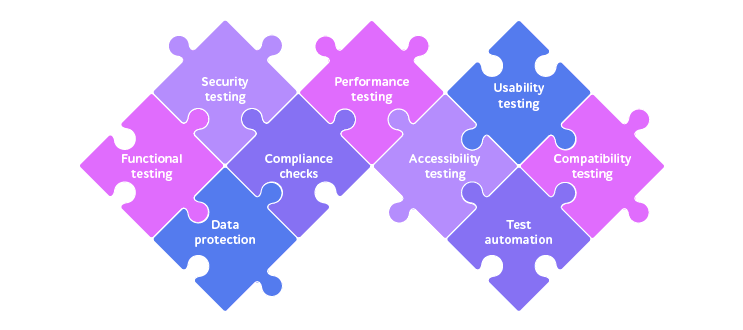
These are the main testing types that are to be included in the testing strategy while working with financial technology software. It is also important to conduct regression testing to ascertain that any changes enhancing user experience haven’t damaged the security, accuracy, compliance, and other issues and wisely automate it as much as possible.
Along with that, checking the usability for boosting user experience and ensuring rigorous compatibility with different OSs and environments are important too.
While these testing areas remain essential, their scope and execution have evolved significantly — particularly in security, performance under peak loads, and resilience testing.
Since this article first appeared, fintech testing has expanded beyond app-level stability. Today, QA teams increasingly address regulatory-driven resilience, system-wide security risks, and dependencies across complex fintech ecosystems.
Related in‑depth guides:
- Fintech resilience and DORA compliance: how QA helps meet regulatory demands
- Key fintech trends and the QA practices shaping financial software today
- Why QA is mission‑critical for financial and banking apps
- QA for cybersecurity resilience
Summing up
While fintech technologies and risks continue to evolve, strong testing foundations remain essential. Building on these principles allows teams to adapt QA strategies to new regulatory, security, and operational challenges.
If you’re evaluating or evolving your fintech QA strategy, reaching out for an expert review can help identify risks early and reduce long-term costs.