

Compatibility testing
a1qa tests compatibility with


Our app compatibility testing services

Cross-browser compatibility testing

Cross-platform compatibility testing
Mobile compatibility testing consultancy and services
We verify the uniformity of user experience through cross-device testing against a multitude of issues and aspects specific to mobile hardware, OSs, and network conditions. To provide for all possible nuances, a1qa uses its fleet of 300+ mobile devices.
























How we test for compatibility
-
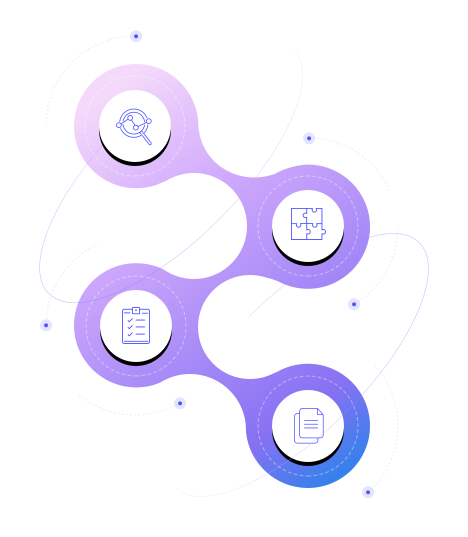
Analysis
We start our application compatibility testing with an in-depth consultancy phase that focuses on the analysis of your product’s specifics, its target audiences and markets, and your business objectives.
-
Compatibility matrix
Based on the defined set of user environments and compatibility requirements, we build a matrix to map out all potential interaction configurations, prioritize them, and select relevant testing methods.
-
Test execution
Our QA engineers perform rigorous compatibility testing using a combination of manual and automated testing methods according to the matrix outlined at the previous stage, ensuring comprehensive coverage of mobile, web, and desktop testing compatibility scenarios.
-
Report
We deliver highly detailed reports uncovering all detected defects across targeted environments, and provide recommendations for overcoming these challenges and making your product all-round compatible.



Why turn to a1qa for compatibility testing?

20+ years of software testing excellence

Testing done with minimal overheads

100% successful test execution

Flexible engagement and pricing models

On-demand testing resources available

Transparent project traceability
Frequently asked questions
Compatibility testing involves checking how your application behaves across different browsers, operating systems, devices, and screen resolutions. By covering everything from OS-level performance to UI differences, compatibility testing helps ensure a uniform and stable user experience.
QA engineers with relevant skills and expertise typically handle compatibility testing. They build a matrix mapping out all the target devices, platforms, and browsers and run both manual and automated tests to detect any performance or UI inconsistencies across every environment.
By detecting incompatibilities early in the project, compatibility testing specialists help their clients prevent negative user feedback, costly patches, or reworks after launch. Ensuring a smooth user experience across all target platforms also helps reduce customer support overheads and reinforce your product’s reputation.
Compatibility matrix represents a grid of environments, including hardware, platforms, browsers, and specific builds, used to determine where software must be validated. We analyze your audience, software specs, and analytics on the most used devices, browsers, OSs, and screen resolutions among your end users to pinpoint the most critical setups, helping focus testing resources in the most effective way.
We check application behavior on diverse browsers, mobile units, screen dimensions, and system versions, testing the interface design, overall utility, and responsiveness in authentic environments. This helps guarantee a seamless and dependable experience for users on every supported device.
We maintain a mix of 300+ commonly used devices, carefully selected based on the market usage, the latest technological updates, and your target audience.
We use traffic statistics, targeting specific setups most popular with core users. This involves reviewing site analytics, current market trends, and vital user groups to pinpoint high-priority platforms. Rarer configurations are checked later to maintain a smart balance between thorough and properly allocating project resources.
Yes. We rely on usage patterns and commercial requirements to identify which older versions truly matter. This results in ensuring software is stable and usable for those visitors, even if it lacks some of the visual polish seen on newer platforms.
We test software on a spectrum of screen scales, shapes, and magnification levels, examining responsive flows, element spacing, font readability, and navigation across these variations. This helps confirm that the interface adjusts correctly and provides a reliable experience on different screens and display setups.
We host software in environments that match your intended deployment. This includes auditing operational logic, data processing, and stability in each scenario to find any unique environment conflicts.