
Hardening sprints in SAFe
Blog

Hardening sprints in SAFe: how to add value to the project without coding and testing

Hardening sprints are regular activities in SAFe. Check out this blog post to learn how our QA team used them to the project’s advantage. 
17 April 2017
Agile
Quality assurance
Article by Vitaly Prus
Head of testing department at a1qa

As we mentioned earlier, SAFe divides the development timeline into a set of five sprints within a Program Increment (PI). However, that is not 100 percent true. There are four full-fledged sprints and a HIP sprint at the tail end of the series.

In this article, we’ll outline the HIP sprint purposes, values, and prospects from the point of view of QA.

What does NOT happen during the HIP sprint?

Ideally, coding and testing should be terminated before the HIP sprint kicks off. So there should be no developing and testing activities during the HIP sprint.

Then what?

The sprint title stands for hardening, innovation, and planning. Each of the components gives us a hint about the purposes of the HIP sprint.
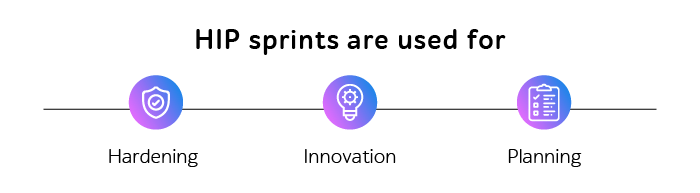
HIP sprints
  • Hardening: Ensures that all PI objectives are achieved, and technical debt is reduced. Time is given to go through checklists again and demonstrate Potentially Shippable Increment (PSI) to stakeholders.
  • Innovation: Provides time for teams to turn up to a hackathon, pitch new ideas, or introduce some innovations.
  • Planning: Conducts Retrospective and completes the planning of the next PI.

HIP sprints in QA: no time for innovation. Why?

No doubt, HIP sprints provide great opportunities for creative guys to offer any new ideas and even try to put it in place. However, as for QA, reality is a bit different.

Most often, we use this time to finalize all tests that were left behind in the fourth sprint. The reasons why the tests weren’t complete in time vary: features delivery was halted, the number of defects grew, or there might arise one blocking defect that prevented the team from doing their job.

If the product release is around the corner, the QA team will be busy running final performance and integration tests that couldn’t be conducted before as every team was committed to their own user story.

It goes without saying that developers do enjoy greater opportunities during the HIP sprint.

But nothing is impossible, and we also managed to make time and think about the future. Developing automated scripts with the client’s data is what we were engaged in during the HIP sprint. These tests were launched every time before the service pack was delivered to the production.

Test automation enabled us to save about 30 hours of manual testing every two weeks. Moreover, automated tests help to increase test coverage: now we could apply them for every client, not for the single ones, as we did before.

That’s it! As you see, the HIP sprint is not a myth, but quite a real thing in SAFe. And while there’s no new functionality delivered, it brings great value to the project.

Now it’s your turn to speak up! Have you tried HIP sprints in SAFe? If using Scrum, how do you allow time for hardening and innovation activities? Please share your thoughts in the comments below.


More Posts

15 December 2025,
by a1qa
4 min read
Compatibility testing: how to protect revenue, reputation, and delivery speed
Modern users expect your app to work first time on whatever device they pick up. A clear compatibility strategy helps your team uncover environment-specific defects before launch, cut noisy support tickets, and keep revenue critical journeys running smoothly.
Quality assurance
28 November 2025,
by a1qa
6 min read
Embarking on the journey ahead: QA trend playbook for 2026
Dive into the wave of QA advancements preparing to take center stage in 2026, arming yourself with the foresight you need to navigate any challenges with confidence. 
Blockchain app testing
QA trends
Quality assurance
Test automation
14 November 2025,
by a1qa
5 min read
QA’s role in a cloud move: before, during, and after
Do not wait until go-live to find bugs. Learn how a continuous QA strategy turns a high-stakes cloud move into a controlled success.

Cloud-based testing
Functional testing
Quality assurance
30 October 2025,
by a1qa
5 min read
Why media and entertainment needs smarter QA
Your audience expects instant, crystal clear streaming every time. Learn how the right QA approach helps your team catch issues before release, protect ad revenue and keep viewers watching.
Quality assurance
15 October 2025,
by a1qa
3 min read
5 signs you need test automation
When manual checks throttle delivery, speed and quality both suffer. If time to market is stretching and incidents keep coming, these five signals say automate now.
Quality assurance
Test automation
30 September 2025,
by a1qa
4 min read
eLearning with AI elements: a practical testing strategy leaders can trust
AI lifts learning outcomes and engagement, but it also raises risk. Here is a clear, business-first testing strategy that helps leaders release reliable AI-powered eLearning, adapt it to local needs, and prove value quickly.
Quality assurance
Test automation
11 September 2025,
by a1qa
5 min read
7 reasons why businesses need load testing 
Want to optimize software performance or ensure its smooth functioning during peak sales season? Discover how load testing may help.
Performance testing
Quality assurance
Test automation
14 August 2025,
by a1qa
4 min read
Output-based test automation, who gains the most?
Linking payment to clear testing deliverables sounds simple. Yet the model reshapes budgets, incentives, and release velocity. Here is how output-based engagement works, where it excels.
Quality assurance
Test automation
23 July 2025,
by a1qa
6 min read
Rewriting the rules: how AI is transforming game quality assurance
Better games, faster updates, happier players, sounds great, right? Learn how to achieve all of these with a smart QA approach.
Performance testing
QA in Gaming
Quality assurance
Test automation

Get in touch

Please fill in the required field.
Email address seems invalid.
Please fill in the required field.
We use cookies on our website to improve its functionality and to enhance your user experience. We also use cookies for analytics. If you continue to browse this website, we will assume you agree that we can place cookies on your device. For more details, please read our Privacy and Cookies Policy.