
Output-based test automation, who gains the most?

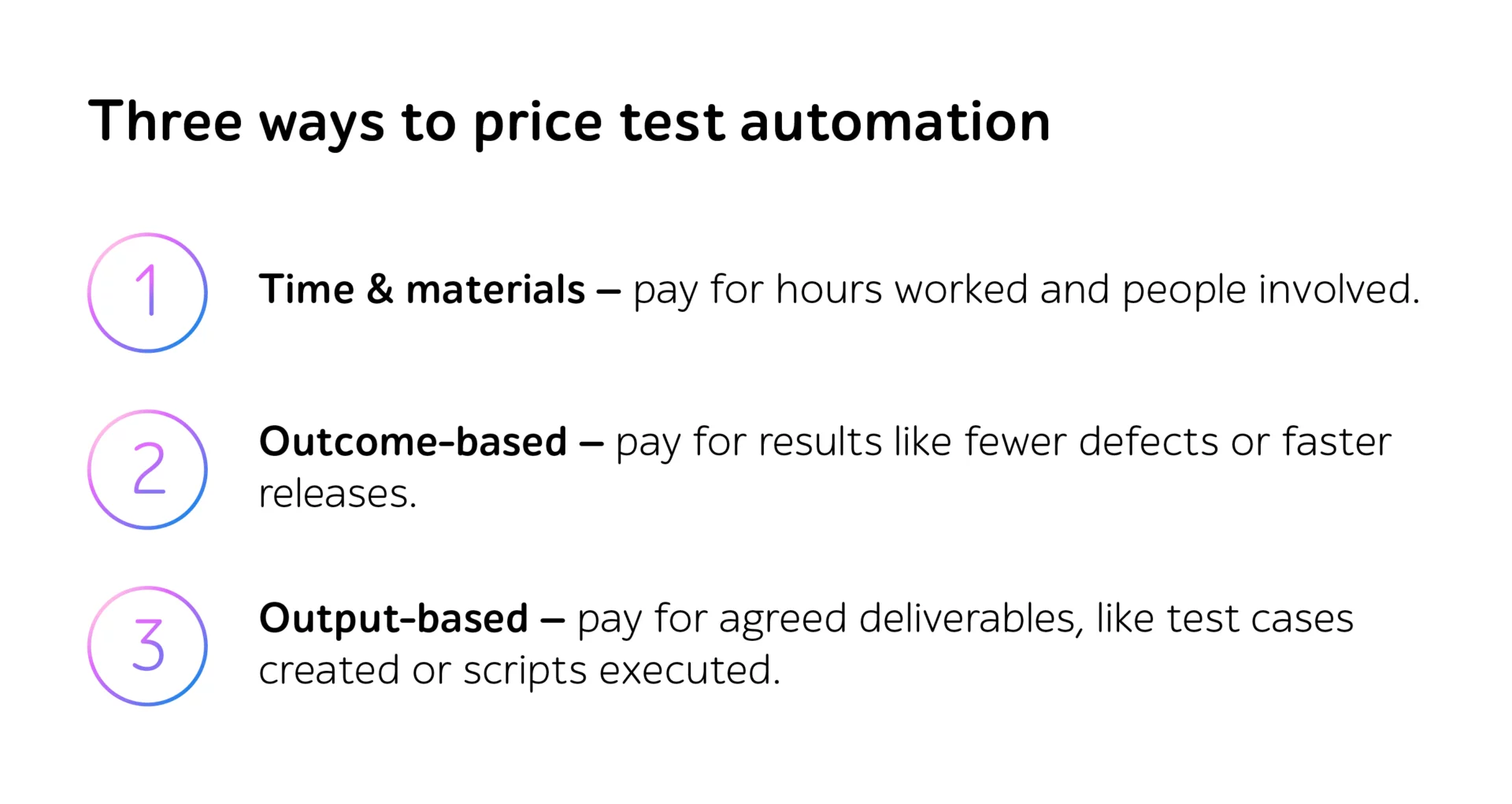
In test automation, there are several ways to define how services are priced and delivered. Traditional models focus on time and materials: you pay for the hours worked and the number of people involved. Outcome-based models set the fee according to the results achieved, such as reducing defects or speeding up releases.
What is output-based engagement?
Output-based engagement sits between these two. It links payment to tangible, agreed-upon deliverables. For example, the number of automated test cases created or scripts executed. You are buying a measurable unit of work, not just effort, and not an abstract business promise.
Why does that distinction matter? Because it shifts the focus from simply keeping a team busy to delivering defined, trackable outputs. For leaders managing complex digital initiatives, that can be the difference between a project that drifts and one that delivers exactly what is needed.
Advantages of this model
Cost predictability
Once the unit price is signed, every additional automated case or executed cycle costs the same. Budget variance falls. Predictable spend means less risk of late-night finance meetings trying to explain why QA costs have blown out.
Efficiency incentive
A vendor cannot charge extra hours when effort spikes. Profit depends on delivering more units from the same resource pool. The incentive is clear: work smarter, not just harder.
Scalability
Testing-as-a-Service lets teams purchase only what they consume, which is ideal for projects with uneven demand. Why pay for idle capacity when the work simply isn’t there?
Risk transfer
If the vendor under-delivers, invoice prices fall. Performance risk is on the supplier side, not with the client’s budget. In other words, underperformance stops being the client’s financial problem.
Transparency and accountability
With pricing tied to deliverables, both sides have a shared understanding of what success looks like. This reduces the risk of misalignment during execution and makes vendor performance easier to evaluate against agreed output targets.
Simplified contract management
Fixed unit pricing streamlines procurement, invoicing, and reporting. Instead of tracking hourly logs or debating time spent, teams focus on whether agreed outputs were delivered, reducing the administrative overhead.
Challenges worth addressing early
Quantity replacing quality
When payment depends on the number of units delivered, the focus can shift to producing more for less. That might mean running cheaper, shallow tests just to meet the target. Without safeguards, this reduces the ability to detect real defects. Setting clear acceptance criteria, running random audits, tracing each test back to requirements and also having a clear and sound testing strategy and testing model helps keep attention on meaningful coverage.
Accurate pricing
Agreeing on a fair unit price is critical. Undervaluation squeezes quality. Overvaluation erodes savings. A short pilot with 5-10 tests provides the data both parties need before scale-up. Why guess when you can measure first?
Scope fluidity
When requirements change often, a fixed list of priced units can quickly become outdated. This can leave important new tasks outside the agreed scope. One way to handle this is with a hybrid contract that includes a small budget for ad-hoc work. This keeps flexibility while still giving price certainty for most of the project.
Who benefits most from output-based contracts?
Enterprises with strict compliance or audit needs
In finance, healthcare, gaming, and other regulated sectors, the ability to prove that testing meets agreed standards is a legal and operational necessity. Output-based automation supports this by documenting the exact number of tests executed, maintaining consistent coverage for critical workflows, and providing traceable evidence that can stand up to audits. This transparency is especially valuable when industry standards or laws mandate specific testing thresholds. If the regulator calls tomorrow, could you produce the evidence without panic?
Organisations managing large, stable systems
For mature applications whose core functionality changes rarely, a stable regression suite is often the best defence against defects. Output-based automation ensures predictable test coverage across releases, reduces the chance of critical errors slipping into production, and scales efficiently when new modules or integrations are introduced. This makes it particularly well-suited to long-lifecycle systems such as ERP platforms and core banking applications, where quality must remain high over years, not months.
Businesses that need budget predictability
In many enterprises, CFOs and programme managers rely on models where spending and deliverables align clearly. Output-based contracts link cost directly to test volume, making forecasting straightforward and reducing the risk of uncontrolled scope creep. For organisations working within tight or fixed budgets, this clarity enables more confident planning and resource allocation without sacrificing quality control. Who would turn down the chance to lock in both cost and coverage?
Leaders driving efficiency gains
For managers tasked with cutting manual testing effort without increasing risk, output-based automation can be transformative. By setting a defined number of automated runs, teams can significantly lower repetitive workload, freeing skilled QA engineers to focus on higher-value activities such as exploratory testing, usability reviews, and complex scenario validation.
Global programmes seeking consistent execution
In multi-region or multi-vendor environments, maintaining consistent QA standards can be challenging. Output-based automation establishes a uniform baseline of automated coverage, ensures each release passes through the same measurable checks, and reduces variability between distributed teams. For brands with a global presence, this consistency safeguards both product quality and customer experience across markets.
Conclusion
Deliverable-linked pricing is not a universal solution, but it closely reflects the direction many organisations are moving in. Higher levels of automation, faster release cycles, leaner teams, and a focus on measurable value are becoming standard practice. As tools continue to evolve, these models may expand beyond regression and performance testing into areas such as accessibility and security.
However, strong governance remains essential. Without it, output-focused approaches risk turning into script-counting exercises rather than supporting real quality improvements.
When calibrated correctly and managed well, output-based engagement aligns spending with visible progress. It offers cost predictability, promotes vendor accountability, and adjusts smoothly to shifts in demand. While it is not suited to every situation, particularly where requirements change frequently or exploratory testing dominates, it can be a powerful model for repeatable, automation-friendly work.
In the right context, unit pricing transforms testing from a fluctuating cost into a planned investment directly tied to delivery.
Reach out to our experts to see how a1qa can help keep your QA costs predictable.